Federal Tax Rate History: Top Marginal Rate by Year
Facts verified: against 2 source-backed data records; page sources include IRS Statistics of Income Historical Table 23 + IRS 2026 tax guidance
Reviewed by Josh for financial modeling and data. See more by Josh.
The top marginal federal income tax rate was 7% when the modern income tax began in 1913, peaked at 94% in 1944 and 1945, reached a modern low of 28% from 1988 through 1990, and is 37% in 2026.
Primary series: IRS Statistics of Income Historical Table 23.
What this history measures
This page follows the IRS highest-bracket regular income-tax rate, including the credits and surcharges identified in Table 23. It does not show every bracket or the effective rate people actually paid. For the full thresholds by filing status, open the tax-bracket archive; for current planning, use the 2026 federal tax-bracket table.
Read the source footnotes: the 1923 credit and 1968-1970 surcharges affect this series, as does the 1981 reduction. For 1988-1990, the IRS table reports 28%, but a temporary 33% phaseout band also applied. The 1944-1945 rules included a 90% effective-rate cap on statutory net income. Dollar conversions use the Minneapolis Fed's estimated 2026 annual CPI, not a completed-year observation.
Swipe horizontally to explore the full timeline. Tap the chart to read an exact value.
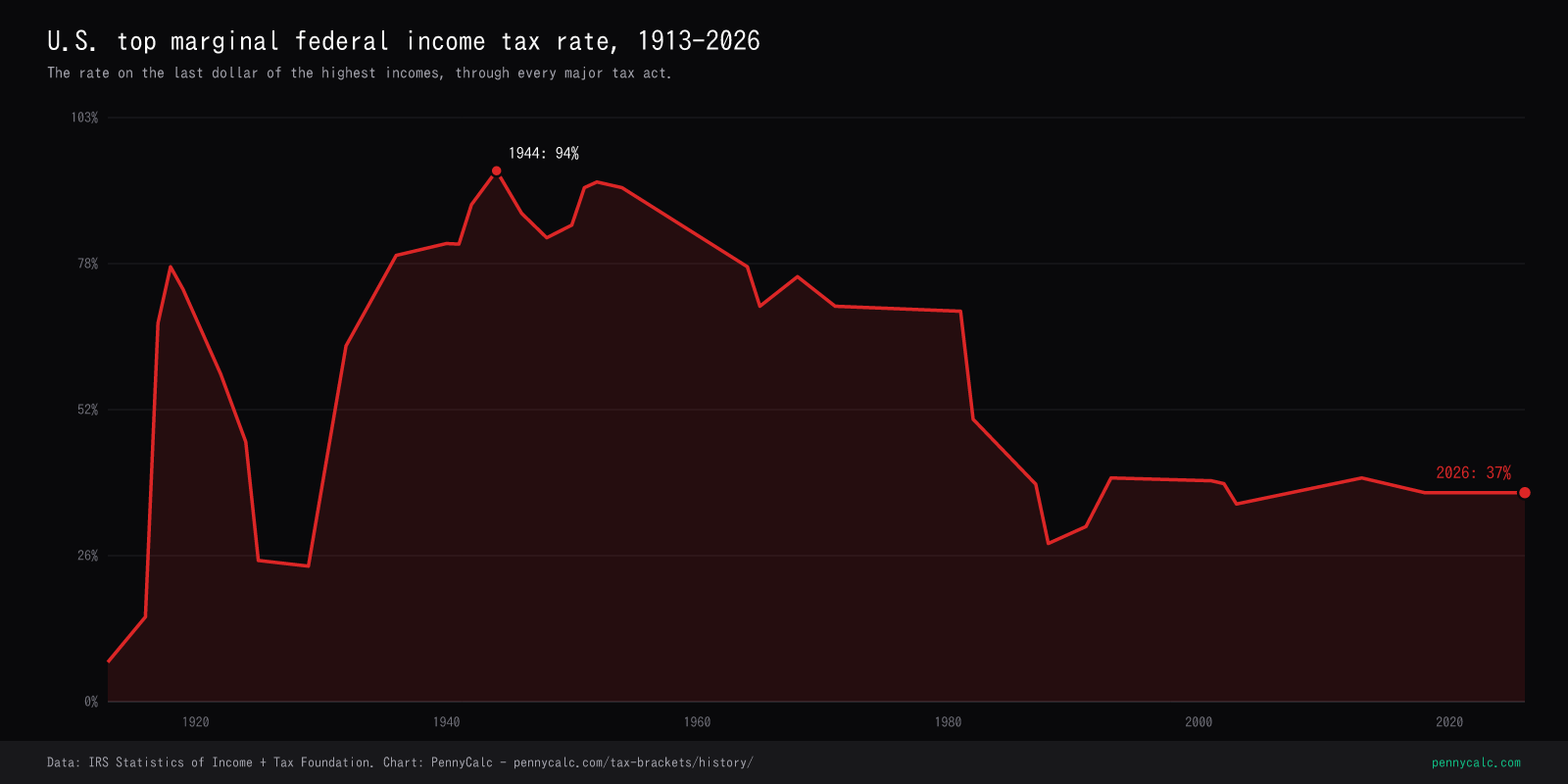
Download this chart: PNG light · PNG dark - PennyCalc chart artwork is reusable under CC BY 4.0 with attribution; source-data terms still apply. Licensing details.
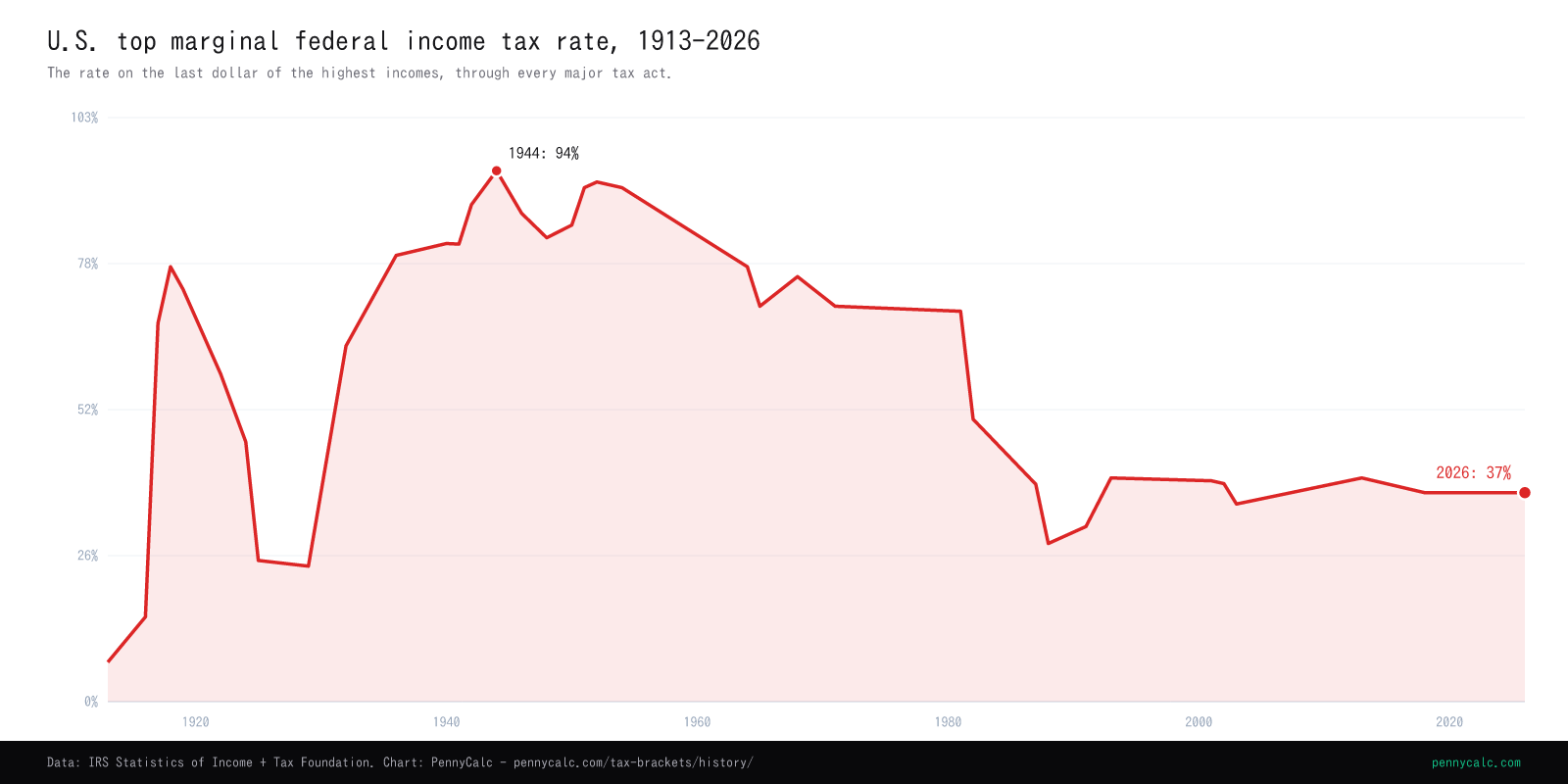
Across the 1913-2026 annual series, the simple mean of the highest-bracket rate is 56.2%. That statistic describes the published rate, not the income threshold, deductions, or effective tax paid.
The major tax acts, in narrative order
Tax brackets are set by Congress, not the President. Below are the legislative milestones that drove the line on the chart above.
Revenue Act of 1913 - the income tax begins
Ratification of the 16th Amendment in February 1913 cleared the constitutional barrier that had killed the federal income tax in Pollock v. Farmers' Loan & Trust (1895). The Revenue Act passed in October 1913 introduced a 1% normal tax on income over $3,000 and a graduated 1-6% surtax that brought the top rate to 7% on income above $500,000 - roughly $16.9M in 2026 dollars. Fewer than 1% of households filed.
WWII transforms the tax - and how it is collected
The Revenue Act of 1942 raised the top rate to 88% and sharply broadened the income-tax base. The Current Tax Payment Act of 1943 then put wages and salaries on a pay-as-you-go withholding system beginning July 1, 1943. The Individual Income Tax Act of 1944 pushed the top rate to 94% on income over $200,000. The rate peak and the withholding system came from separate laws, even though they are often compressed into the same wartime-tax story.
Revenue Act of 1964 - Kennedy-Johnson cuts
Proposed by Kennedy and signed by Johnson, the 1964 act cut the top rate from 91% to 77% in one year, and to 70% by 1965. The later Vietnam-era surcharge raised the IRS table's rate to 75.25% in 1968, 77% in 1969, and 71.75% in 1970.
ERTA and TRA86 - the Reagan-era restructuring
The Economic Recovery Tax Act of 1981 (ERTA, also called Kemp-Roth) lowered the top rate to 50% in 1982 and provided for bracket indexation beginning in 1985. The IRS table reports 69.125% for 1981 after that year's rate reduction. The Tax Reform Act of 1986 phased the highest-bracket rate down to 38.5% in 1987 and 28% in 1988. The 1988-1990 schedules also included a temporary 33% band that phased out the benefit of the 15% bracket; a chart showing only 28% does not display that full schedule.
Deficit-driven hikes
OBRA 1990 added a 31% bracket (and broke George H.W. Bush's 'read my lips' pledge). OBRA 1993 added 36% and 39.6% brackets and uncapped the Medicare wage base. By 2000, the top federal rate was 39.6% - and the federal budget was in surplus.
EGTRRA and JGTRRA - the Bush cuts
EGTRRA (2001) phased the top rate down from 39.6% to 35%, created the 10% bracket, and doubled the child tax credit. JGTRRA (2003) accelerated those cuts and dropped the long-term capital gains and qualified dividend rates to 15%. Both bills were enacted via budget reconciliation, which is why their provisions sunset - and why every Bush-era rate fight since has been about which provisions to extend.
ATRA - the 'fiscal cliff' resolution
The American Taxpayer Relief Act of 2012 (passed Jan 2, 2013) made most Bush cuts permanent but restored the 39.6% top bracket on the highest earners. Separately, the ACA's 3.8% Net Investment Income Tax took effect, and the 0.9% Additional Medicare Tax began on wage income over $200,000 / $250,000.
TCJA - largest reform since 1986
The Tax Cuts and Jobs Act lowered the top rate from 39.6% to 37%, doubled the standard deduction, capped the State and Local Tax (SALT) deduction at $10,000, killed personal exemptions, expanded the Child Tax Credit, and created the §199A pass-through deduction. Critically, the corporate cut was made permanent while individual provisions were scheduled to sunset at end of 2025. Most individual provisions were extended for 2026.
Selected historical income thresholds
A rate alone does not tell you how much income it applied to. These selected thresholds follow IRS Table 23's filing basis, with the 2026 married-filing-jointly threshold from current IRS guidance. They are not a constant-filing-status comparison across the full period.
| Year | Filing basis | Top rate | Top bracket starts (nominal $) | Threshold (estimated 2026 $) |
|---|---|---|---|---|
| 1913 | Individual | 7% | $500,000 | ~$16,888,889 |
| 1944 | Individual | 94% | $200,000 | ~$3,800,000 |
| 1981 | Married filing jointly | 69.125% | $215,400 | ~$792,407 |
| 1988 | Married filing jointly | 28% | $29,750 | ~$84,095 |
| 2000 | Married filing jointly | 39.6% | $288,350 | ~$559,955 |
| 2017 | Married filing jointly | 39.6% | $470,700 | ~$642,195 |
| 2026 | Married filing jointly | 37% | $768,700 | $768,700 |
Sources: IRS SOI Table 23 and IRS 2026 inflation adjustments. CPI conversions use the same annual series as our inflation history, including its estimated 2026 CPI of 334.4. The 1988 threshold is where the 28% bracket began; a temporary 33% phaseout band applied farther up the income schedule.
Things you might not know
- Modern wage withholding began in 1943. The income tax began in 1913, but the Current Tax Payment Act put wages and salaries on pay-as-you-go withholding beginning July 1, 1943. The separate 1944 law raised the top marginal rate to 94%.
- Credits and surcharges matter. The IRS series shows 43.5% for 1923 after a 25% tax credit, and different surcharge-adjusted rates in each of 1968, 1969, and 1970.
- The 28% era also had a 33% band. The 1988-1990 schedules phased out benefits from the lower bracket at certain incomes. The single-line chart cannot show that extra band.
- There were multiple later increases. The highest-bracket rate rose to 31% in 1991, to 39.6% in 1993, and returned to 39.6% in 2013 after a decade at 35%.
- Bracket indexation is younger than ERTA. Before 1981, brackets were defined in nominal dollars and "bracket creep" silently raised effective tax rates as inflation pushed earners into higher brackets. ERTA indexed brackets to CPI starting in 1985.
Top marginal tax rate by year
The complete year-by-year series behind the chart, from the 7% highest-bracket rate of 1913 to today's 37%. See the source-footnote qualifications above.
| Year | Top marginal rate | What changed that year |
|---|---|---|
| 1913 | 7% | 16th Amendment / Revenue Act of 1913 |
| 1914 | 7% | |
| 1915 | 7% | |
| 1916 | 15% | |
| 1917 | 67% | War Revenue Act of 1917 |
| 1918 | 77% | |
| 1919 | 73% | |
| 1920 | 73% | |
| 1921 | 73% | |
| 1922 | 58% | |
| 1923 | 43.5% | |
| 1924 | 46% | Mellon-era cuts (1921-1926) |
| 1925 | 25% | |
| 1926 | 25% | |
| 1927 | 25% | |
| 1928 | 25% | |
| 1929 | 24% | |
| 1930 | 25% | |
| 1931 | 25% | |
| 1932 | 63% | Revenue Act of 1932 |
| 1933 | 63% | |
| 1934 | 63% | |
| 1935 | 63% | |
| 1936 | 79% | |
| 1937 | 79% | |
| 1938 | 79% | |
| 1939 | 79% | |
| 1940 | 81.1% | |
| 1941 | 81% | |
| 1942 | 88% | Revenue Act of 1942 |
| 1943 | 88% | Current Tax Payment Act of 1943 |
| 1944 | 94% | |
| 1945 | 94% | |
| 1946 | 86.45% | |
| 1947 | 86.45% | |
| 1948 | 82.13% | |
| 1949 | 82.13% | |
| 1950 | 84.36% | |
| 1951 | 91% | |
| 1952 | 92% | |
| 1953 | 92% | |
| 1954 | 91% | |
| 1955 | 91% | |
| 1956 | 91% | |
| 1957 | 91% | |
| 1958 | 91% | |
| 1959 | 91% | |
| 1960 | 91% | |
| 1961 | 91% | |
| 1962 | 91% | |
| 1963 | 91% | |
| 1964 | 77% | Revenue Act of 1964 |
| 1965 | 70% | |
| 1966 | 70% | |
| 1967 | 70% | |
| 1968 | 75.25% | |
| 1969 | 77% | Tax Reform Act of 1969 |
| 1970 | 71.75% | |
| 1971 | 70% | |
| 1972 | 70% | |
| 1973 | 70% | |
| 1974 | 70% | |
| 1975 | 70% | |
| 1976 | 70% | |
| 1977 | 70% | |
| 1978 | 70% | |
| 1979 | 70% | |
| 1980 | 70% | |
| 1981 | 69.125% | Economic Recovery Tax Act (ERTA) |
| 1982 | 50% | |
| 1983 | 50% | |
| 1984 | 50% | |
| 1985 | 50% | |
| 1986 | 50% | Tax Reform Act of 1986 |
| 1987 | 38.5% | |
| 1988 | 28% | |
| 1989 | 28% | |
| 1990 | 28% | OBRA 1990 |
| 1991 | 31% | |
| 1992 | 31% | |
| 1993 | 39.6% | OBRA 1993 |
| 1994 | 39.6% | |
| 1995 | 39.6% | |
| 1996 | 39.6% | |
| 1997 | 39.6% | |
| 1998 | 39.6% | |
| 1999 | 39.6% | |
| 2000 | 39.6% | |
| 2001 | 39.1% | EGTRRA (Bush cuts, phase 1) |
| 2002 | 38.6% | |
| 2003 | 35% | JGTRRA (Bush cuts, phase 2) |
| 2004 | 35% | |
| 2005 | 35% | |
| 2006 | 35% | |
| 2007 | 35% | |
| 2008 | 35% | |
| 2009 | 35% | |
| 2010 | 35% | |
| 2011 | 35% | |
| 2012 | 35% | |
| 2013 | 39.6% | American Taxpayer Relief Act (ATRA) |
| 2014 | 39.6% | |
| 2015 | 39.6% | |
| 2016 | 39.6% | |
| 2017 | 39.6% | Tax Cuts and Jobs Act (TCJA) |
| 2018 | 37% | |
| 2019 | 37% | |
| 2020 | 37% | |
| 2021 | 37% | |
| 2022 | 37% | |
| 2023 | 37% | |
| 2024 | 37% | |
| 2025 | 37% | |
| 2026 | 37% |
Full series shown. Scroll within the table to see every year.
Frequently Asked Questions
What was the highest federal income tax rate in U.S. history?
When was the top federal tax rate at its lowest?
Are top tax rates today historically high or low?
Did people actually pay 94% in 1944?
Why does the top rate change so rarely now?
What's the difference between the top marginal rate and the effective tax rate?
What was the top tax rate the year you were born?
Pick a year from 1913 to 2026 to see the top marginal federal rate and a one-line summary of the era.
ERTA lowered the top rate to 50% in 1982 and provided for bracket indexation beginning in 1985.
To run real numbers against today's brackets, use our tax bracket calculator. To see how this rate stacks with state income tax in your paycheck, try the paycheck calculator. For sources and how we update this page, see our methodology.
A top marginal rate does not tell us how much income different households ultimately receive. Our income-distribution history compares income shares before and after means-tested benefits and federal taxes, and explains why tax reform can change both incentives and the way income is reported.
Related tools and reading
Tax Bracket Calculator
Calculate your federal income tax across all 2026 brackets.
Paycheck Calculator
Take-home pay after federal, state, FICA, and pre-tax deductions.
Capital Gains Tax History
Top federal capital gains rate from 1922 to 2026.
Standard Deduction History
How the standard deduction grew from $500 in 1944 to $16,100 today.
Methodology
How we source and verify every rate, limit, and bracket.
2026 Federal Tax Brackets
The current bracket schedule with worked examples.