401(k) Contribution Limit History
Facts verified: against 2 source-backed data records; page sources include IRS Notice 2025-67 + historical IRS guidance
Reviewed by Jessie for editorial clarity and sourcing. See more by Jessie.
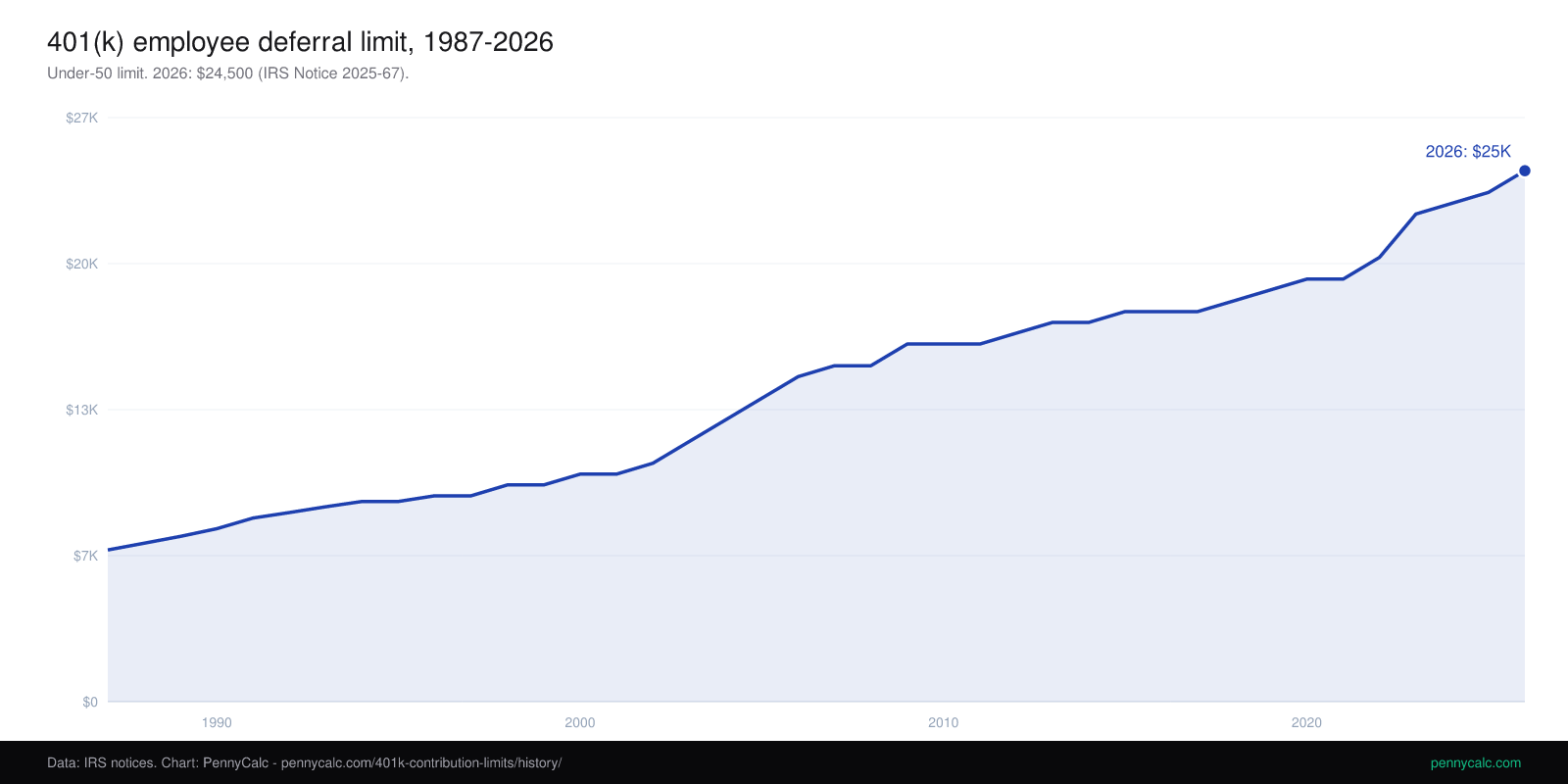
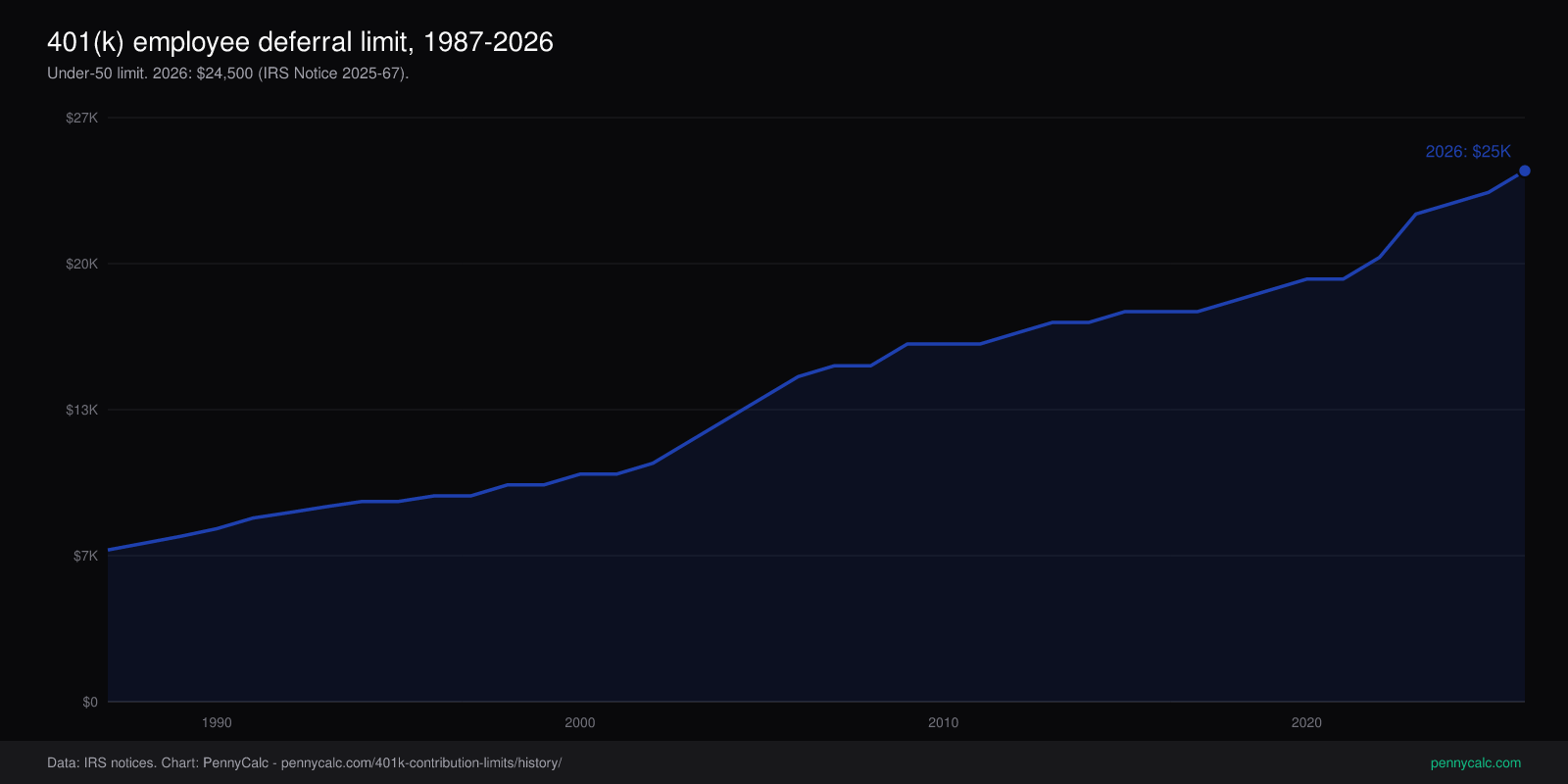
Annual 401(k) employee deferral limit from $7,000 in 1987 to $24,500 in 2026, with EGTRRA acceleration, catch-up introduction, and SECURE 2.0 changes annotated.
2026 limits: IRS Notice 2025-67. Historical sources include prior IRS Notices, EBRI Issue Briefs, Plan Sponsor Council of America, and Internal Revenue Code legislative history.
Swipe horizontally to explore the full timeline. Tap the chart to read an exact value.
Download this chart: PNG light · PNG dark - PennyCalc chart artwork is reusable under CC BY 4.0 with attribution; source-data terms still apply. Licensing details.
The major changes
The 401(k) limit has been shaped by four major pieces of legislation: TRA86 (origin), EGTRRA (acceleration), PPA (auto-enrollment), and SECURE 2.0 (catch-up changes). Below are the milestones.
Section 401(k) of the Revenue Act of 1978 - the original provision
The Revenue Act of 1978 added Section 401(k) to the Internal Revenue Code, allowing employees to defer compensation pre-tax. Plan adoption took several years - the first wave of corporate 401(k) plans launched in 1981 (Johnson Companies is generally credited with the first plan) after IRS issued proposed regulations clarifying that employee deferrals would qualify for tax deferral.
TRA86 sets the modern limit structure
Before TRA86, 401(k) deferrals were governed by ad-hoc rules and a $30,000 combined-contribution limit. The Tax Reform Act of 1986 established the $7,000 employee deferral cap that took effect in 1987, with annual inflation indexation from 1988 forward. TRA86 also required nondiscrimination testing (the ADP/ACP tests) to prevent plans from disproportionately benefiting highly-compensated employees.
EGTRRA - accelerated limit increases
The Economic Growth and Tax Relief Reconciliation Act of 2001 (EGTRRA) accelerated the deferral limit through a fixed schedule: $11,000 in 2002, $12,000 in 2003, $13,000 in 2004, $14,000 in 2005, and $15,000 in 2006, after which the limit returned to inflation indexation. EGTRRA also introduced catch-up contributions for participants age 50+ - $1,000 in 2002 rising to $5,000 by 2006.
Pension Protection Act
The Pension Protection Act of 2006 made permanent the EGTRRA changes (which were originally scheduled to sunset in 2010). PPA also encouraged automatic enrollment, default investment options (the default became a target-date fund), and automatic contribution escalation. These three changes are the structural drivers of the modern 401(k) participation rate, which exceeds 80% in plans with auto-enrollment versus roughly 60% in opt-in plans.
SECURE Act
The Setting Every Community Up for Retirement Enhancement (SECURE) Act of 2019 raised the RMD age from 70.5 to 72, allowed lifetime income annuities in 401(k) plans, opened plan participation to long-term part-time workers, and required employers to provide retirement-income illustrations on 401(k) statements.
SECURE 2.0 Act
SECURE 2.0 (passed late December 2022, effective 2023+) introduced multiple 401(k) changes. It raised the RMD age again (to 73 in 2023, 75 in 2033), created the "super catch-up" for ages 60-63 taking effect in 2025 ($3,750 above the standard catch-up), and required catch-up contributions to go to the Roth bucket for high earners (over $145K W-2 wages, indexed) starting in 2026 (Section 603). It also mandated automatic enrollment for new 401(k) plans starting 2025 with default contribution rates between 3% and 10% and 1% annual auto-escalation up to at least 10%.
Where the limit stands today
The 2026 employee deferral limit is $24,500 ($32,500 with the age-50 catch-up; $35,750 with the higher catch-up for ages 60-63). The Section 415 combined limit for 2026 is $72,000, which caps employer + employee + after-tax contributions combined and effectively determines mega backdoor Roth capacity. The IRS generally announces the following year's limits in the fall.
Things you might not know
- The 401(k) was a side effect of executive deferred-compensation rules. The Section 401(k) provision was originally drafted to clarify the tax treatment of cash-or-deferred arrangements (CODAs) used by executives. Ted Benna at the Johnson Companies pioneered using it as a broad-based employee benefit in 1981.
- The IRS Notice cadence is tight. The IRS publishes the next year's contribution limits each fall (typically October or November) under the Notice series. The 2027 limit will likely be announced in late October 2026.
- Catch-up contributions don't count toward the Section 415 limit. The age-50 catch-up ($8,000 in 2026) is on top of the $72,000 combined cap, not within it. A catch-up-eligible participant could therefore reach $80,000 across all sources if the plan and employer contributions permit it.
- The mega backdoor Roth depends on plan support, not law. The mega backdoor strategy (after-tax contributions plus in-plan Roth conversion) is legal under existing rules, but only some plans support it. Roughly 25-30% of large 401(k) plans currently allow it (per Vanguard's How America Saves report).
- The 2023 jump was the largest single-year increase since EGTRRA. The limit went from $20,500 in 2022 to $22,500 in 2023 - a $2,000 step driven by post-pandemic inflation. Most years see $500 increments.
401(k) employee deferral limit by year
The elective deferral limit from 1987 to 2026, before any employer match or age-50 catch-up. Years not listed held the prior limit.
| Year | Employee deferral limit | What changed that year |
|---|---|---|
| 1987 | $7,000 | TRA86 caps deferral at $7,000 with annual indexation |
| 1988 | $7,313 | |
| 1989 | $7,627 | |
| 1990 | $7,979 | |
| 1991 | $8,475 | |
| 1992 | $8,728 | |
| 1993 | $8,994 | |
| 1994 | $9,240 | |
| 1995 | $9,240 | |
| 1996 | $9,500 | |
| 1997 | $9,500 | |
| 1998 | $10,000 | |
| 1999 | $10,000 | |
| 2000 | $10,500 | |
| 2001 | $10,500 | |
| 2002 | $11,000 | Catch-up contributions for age 50+ introduced |
| 2003 | $12,000 | |
| 2004 | $13,000 | |
| 2005 | $14,000 | |
| 2006 | $15,000 | $15,000 limit under EGTRRA schedule |
| 2007 | $15,500 | |
| 2008 | $15,500 | |
| 2009 | $16,500 | |
| 2010 | $16,500 | |
| 2011 | $16,500 | |
| 2012 | $17,000 | |
| 2013 | $17,500 | |
| 2014 | $17,500 | |
| 2015 | $18,000 | |
| 2016 | $18,000 | |
| 2017 | $18,000 | |
| 2018 | $18,500 | |
| 2019 | $19,000 | |
| 2020 | $19,500 | |
| 2021 | $19,500 | |
| 2022 | $20,500 | |
| 2023 | $22,500 | Largest annual increase ($2,000) since EGTRRA |
| 2024 | $23,000 | |
| 2025 | $23,500 | SECURE 2.0 super catch-up for ages 60-63 takes effect |
| 2026 | $24,500 |
Full series shown. Scroll within the table to see every year.
Frequently Asked Questions
What is the 2026 401(k) contribution limit?
When did 401(k) catch-up contributions start?
How fast has the 401(k) limit grown historically?
What's the difference between the deferral limit and the Section 415 limit?
What happens to my catch-up contributions if I'm a high earner under SECURE 2.0?
Are 401(k) limits set per account or per person?
To project your balance against today's $24,500 limit and the SECURE 2.0 higher catch-up, use our 401(k) calculator. For the broader retirement picture, the retirement calculator stitches together accumulation and drawdown. For sources and update cadence, see our methodology.
Related tools and reading
401(k) Calculator
Project balance at retirement with employer match and 2026 IRS limits.
Roth IRA Calculator
Roth vs. Traditional comparison with MAGI phaseouts and 5-year rules.
Retirement Calculator
Accumulation and drawdown projections with inflation-adjusted withdrawals.
2026 401(k) Contribution Limits
Current-year reference for limits, catch-up, and mega backdoor Roth.