U.S. Standard Deduction History
Facts verified: against 2 source-backed data records; page sources include IRS Rev. Proc. 2025-32 + OBBBA tax-year guidance + historical IRS publications
Reviewed by Josh for financial modeling and data. See more by Josh.
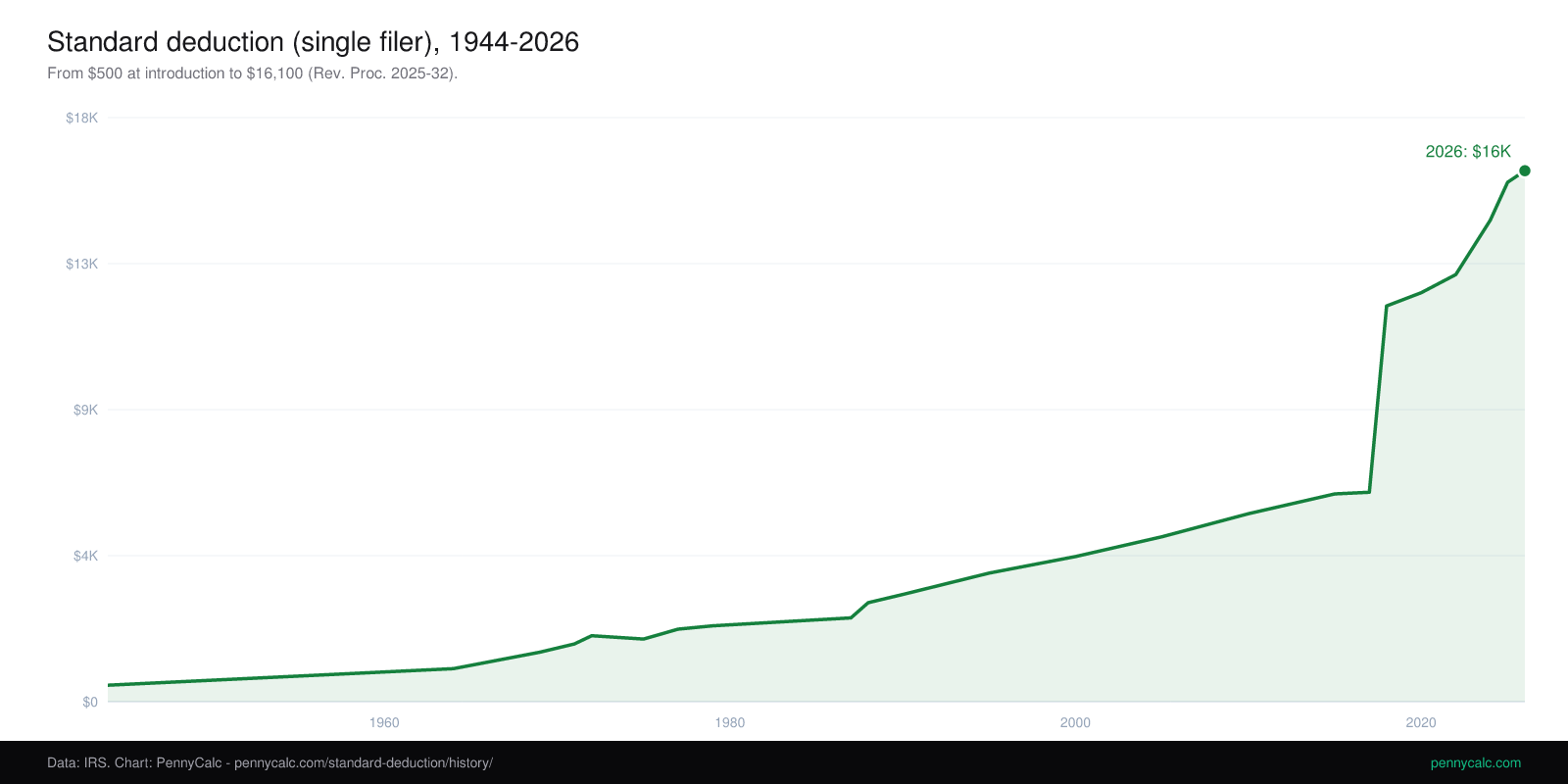
Single-filer standard deduction from the 1944 introduction to the 2026 inflation-adjusted amount of $16,100, with every major legislative change annotated.
Sources: IRS Publication 17 historical tables, Internal Revenue Code legislative history, Tax Foundation, Joint Committee on Taxation.
Swipe horizontally to explore the full timeline. Tap the chart to read an exact value.
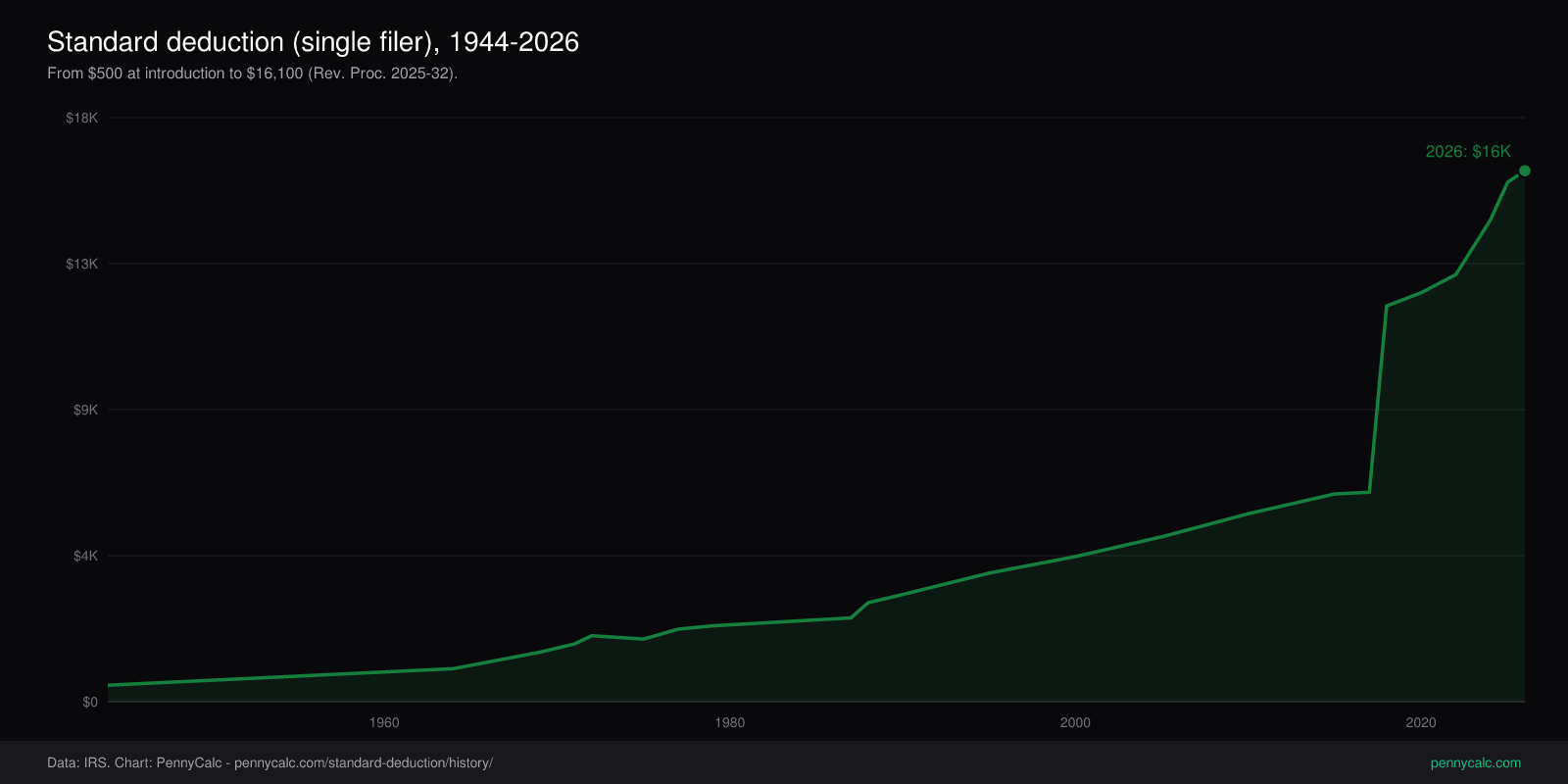
Download this chart: PNG light · PNG dark - PennyCalc chart artwork is reusable under CC BY 4.0 with attribution; source-data terms still apply. Licensing details.
The major changes
The standard deduction has shifted with each major tax reform. Below are the legislative milestones that drove the line on the chart above.
Individual Income Tax Act of 1944 - the standard deduction is born
The 1944 Act introduced the standard deduction at $500 single, $1,000 MFJ. Before 1944, taxpayers either itemized or took an "optional standard deduction" of 10% of income capped at $500. The 1944 Act simplified the rule to a fixed dollar amount, partly to make withholding feasible (which the same Act introduced) and partly to simplify filing for the millions of new wage earners pulled into the income tax during WWII.
Income splitting boosts the joint deduction
The Revenue Act of 1948 created the joint return with income splitting, effectively doubling the MFJ deduction to $1,000 (still $500 single). The "marriage penalty" / "marriage bonus" structure that has shaped tax filing decisions since dates from this Act.
Tax Reform Act of 1969 - $1,500 and the AMT
TRA69 increased the standard deduction to $1,500 single, $2,000 MFJ and tied it to a percentage of income (15% up to a cap) rather than a fixed dollar amount. The same Act introduced the Alternative Minimum Tax to prevent high earners from using deductions to drive their tax liability to zero.
Renaming to "zero bracket amount"
The Tax Reduction and Simplification Act of 1977 absorbed the standard deduction into the tax tables themselves under the name "zero bracket amount" (ZBA). Functionally identical, but presented to taxpayers differently. The 1977 single amount was $2,200.
ERTA inflation indexing begins
The Economic Recovery Tax Act of 1981 required brackets and the standard deduction to be indexed to inflation starting in 1985. Before ERTA, the deduction was static in nominal dollars and "bracket creep" silently raised effective tax rates as wages grew. The 1985 amount was $2,480, the first inflation-indexed single deduction.
TRA86 phase-in complete
The Tax Reform Act of 1986 reorganized the deduction structure, increasing the single deduction from $2,540 in 1987 to $3,000 in 1988 and the MFJ deduction to $5,000. TRA86 also restored the "standard deduction" terminology, retiring the ZBA name. The 1988 deduction was the highest in real-dollar terms since 1944.
TCJA roughly doubles the standard deduction
The Tax Cuts and Jobs Act of 2017 took effect in 2018 with the most consequential standard-deduction change since 1944. The single deduction jumped from $6,350 to $12,000, and MFJ went from $12,700 to $24,000. The trade-off: TCJA also eliminated personal exemptions ($4,050 each in 2017) and capped SALT deductions at $10,000. The net effect made itemizing significantly less common: the share of itemizers dropped from roughly 30% of returns in 2017 to about 11% in 2018 (IRS SOI).
OBBBA permanence and the $16,100 2026 deduction
The One Big Beautiful Bill Act made the TCJA-era structure permanent and increased the 2025 amounts. The IRS then applied its 2026 inflation adjustment. The 2026 standard deduction is $16,100 single, $32,200 MFJ, and $24,150 HoH.
Things you might not know
- The standard deduction is younger than the income tax. The federal income tax began in 1913. The standard deduction wasn't introduced until 1944, three decades later.
- TCJA didn't simply double the deduction. It also eliminated personal exemptions ($4,050 per person in 2017), so families of four saw a much smaller net change than the headline doubling implied.
- The itemizing share collapsed in 2018. About 30% of returns itemized in 2017; only about 11% have itemized since TCJA took effect (IRS SOI). The doubled standard deduction plus the SALT cap pushed most middle-income filers off itemizing entirely.
- Inflation indexation switched in 2018. ERTA established annual inflation adjustment using regular CPI. TCJA switched to chained CPI, which grows about 0.25 percentage points slower per year. That gap compounds over time and is why the post-TCJA deduction has grown a little slower than pre-TCJA growth would have produced.
- Some states track the federal deduction; many don't. About 21 states use the federal standard deduction directly. The rest use their own deduction (often much smaller) or eliminate the standard deduction entirely. State tax filing complexity often exceeds federal complexity for this reason.
Standard deduction by year (single filer)
The single-filer standard deduction behind the chart, from 1944 to 2026. Married filing jointly is roughly double in every year. The 2018 jump reflects the Tax Cuts and Jobs Act nearly doubling the deduction.
| Year | Standard deduction (single) | What changed that year |
|---|---|---|
| 1944 | $500 | Individual Income Tax Act of 1944 - standard deduction introduced |
| 1964 | $1,000 | |
| 1969 | $1,500 | Tax Reform Act of 1969 - increased threshold |
| 1971 | $1,750 | |
| 1972 | $2,000 | |
| 1975 | $1,900 | |
| 1977 | $2,200 | Tax Reduction and Simplification Act renames "zero bracket amount" |
| 1979 | $2,300 | |
| 1985 | $2,480 | ERTA inflation indexing begins |
| 1987 | $2,540 | |
| 1988 | $3,000 | Tax Reform Act of 1986 phase-in completes |
| 1990 | $3,250 | |
| 1995 | $3,900 | |
| 2000 | $4,400 | |
| 2005 | $5,000 | |
| 2010 | $5,700 | |
| 2015 | $6,300 | |
| 2017 | $6,350 | |
| 2018 | $12,000 | TCJA roughly doubles the standard deduction |
| 2020 | $12,400 | |
| 2022 | $12,950 | |
| 2024 | $14,600 | |
| 2025 | $15,750 | One Big Beautiful Bill Act makes the TCJA structure permanent and raises the deduction |
| 2026 | $16,100 | IRS applies the first post-OBBBA inflation adjustment |
Full series shown. Scroll within the table to see every year.
Frequently Asked Questions
What is the 2026 standard deduction?
When did the standard deduction start being inflation-indexed?
How much did TCJA actually change the standard deduction?
What share of taxpayers itemize vs. take the standard deduction?
What's the difference between the standard deduction and the personal exemption?
Should I take the standard deduction or itemize?
To check today's standard deduction against your bracket, use our tax bracket calculator. For the current 2026 bracket schedule, see 2026 federal tax brackets. For sources and update cadence, see our methodology.
Related tools and reading
Tax Bracket Calculator
See your marginal and effective federal tax rates for any income.
2026 Tax Brackets
Current-year brackets, deductions, and worked examples.
Federal Tax Brackets History
Top marginal personal income tax rate from 1913 to 2026.
Paycheck Calculator
Estimate take-home pay after federal, state, and FICA withholding.