Social Security Wage Base History
Facts verified: against 2 source-backed data records; page sources include SSA contribution and benefit base table for the 2026 taxable maximum
Reviewed by Jessie for editorial clarity and sourcing. See more by Jessie.
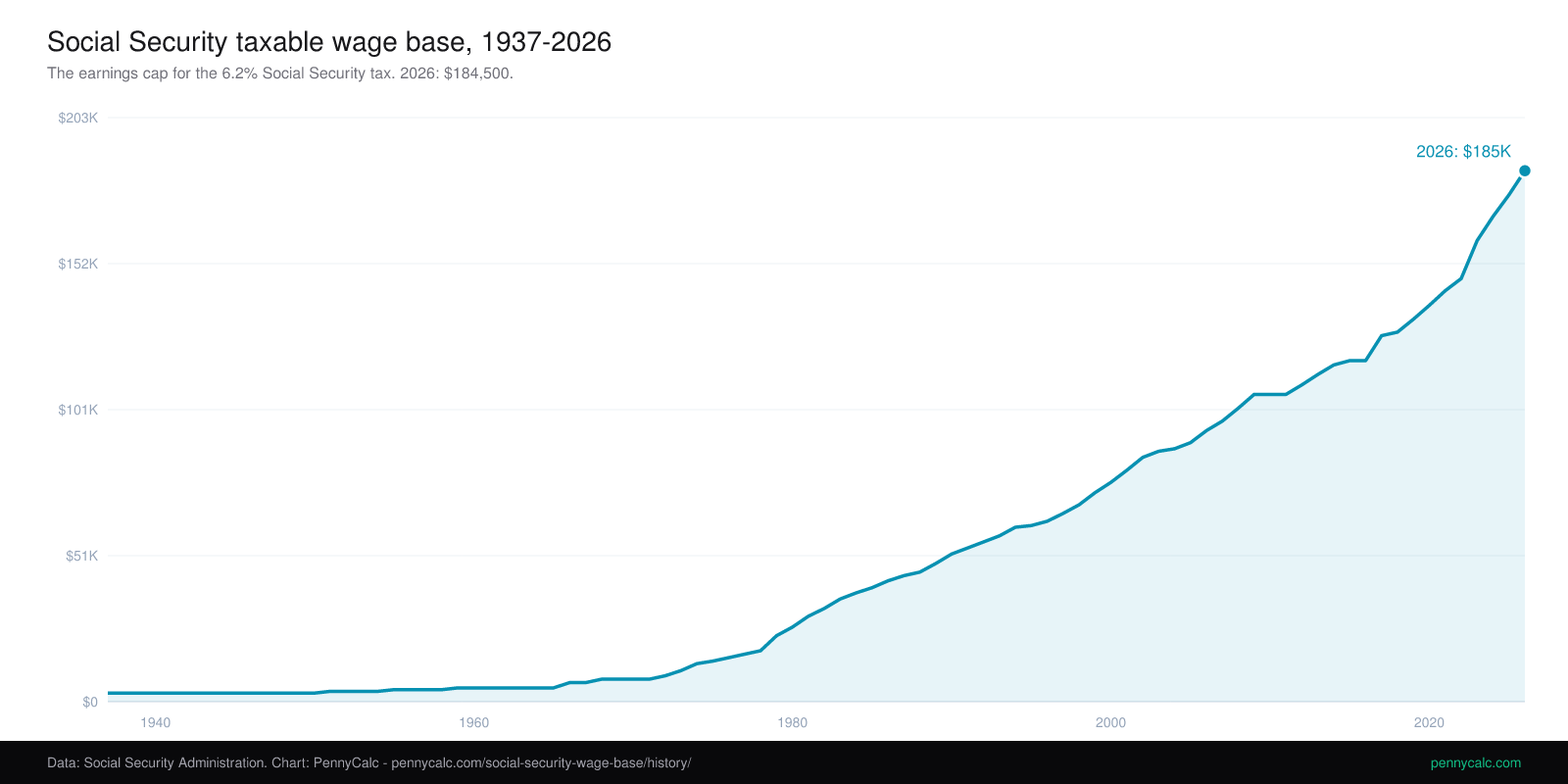
All 90 annual Social Security taxable wage-base values from $3,000 in 1937 to $184,500 in 2026, with major legislative milestones annotated.
Primary sources: SSA Office of the Chief Actuary wage-base table, SSA's Social Security Fairness Act update, and IRS Topic 554.
Swipe horizontally to explore the full timeline. Tap the chart to read an exact value.
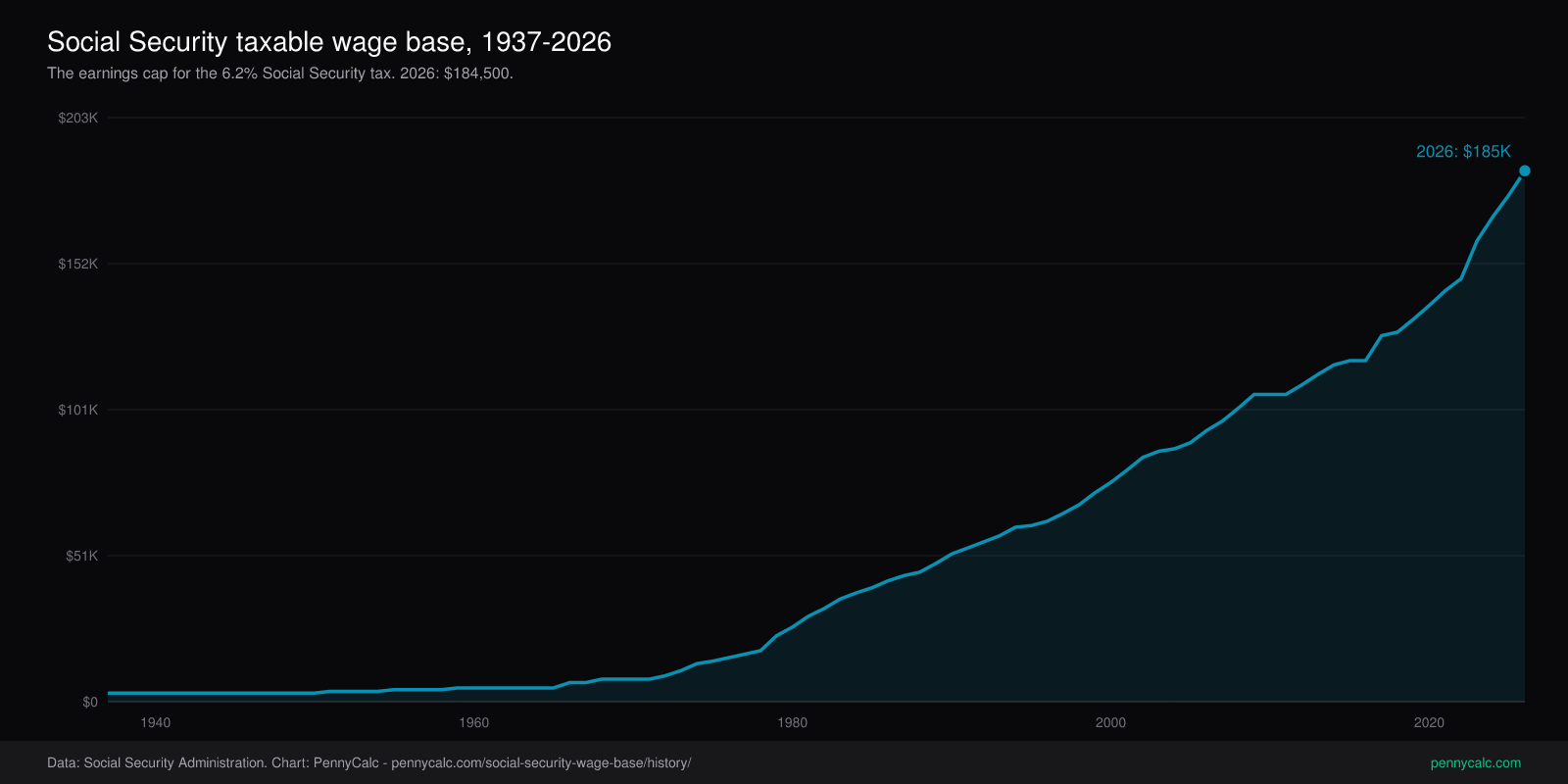
Download this chart: PNG light · PNG dark - PennyCalc chart artwork is reusable under CC BY 4.0 with attribution; source-data terms still apply. Licensing details.
The major changes
The Social Security wage base has been shaped by three structural changes: the 1972 shift to automatic wage indexation, the 1983 Greenspan Commission reforms, and the 1993 separation of Medicare from the Social Security cap.
Social Security Act and the original $3,000 wage base
The Social Security Act of 1935 set the original taxable wage base at $3,000. Tax collections and one-time lump-sum benefits began in 1937; the first recurring monthly benefits were paid in 1940. The 6.2% employee + 6.2% employer rate that we use today was not in place from the start - the original rate was 1% each side, scheduled to rise gradually. The $3,000 base in 1937 dollars equates to roughly $70,000 in 2026 purchasing power.
Periodic legislative adjustments
The wage base required Congressional action to change for the first 35 years of Social Security. Adjustments were infrequent and political: $3,600 in 1951, $4,200 in 1955, $4,800 in 1959, $6,600 in 1966, $7,800 in 1968. By the late 1960s the base had fallen meaningfully behind wage growth, contributing to the financial pressures that produced the 1972 amendments.
Automatic wage indexation is established
The 1972 amendments established a formula tying the wage base to growth in the National Average Wage Index (NAWI), reducing the need for Congressional action. The first automatically adjusted base took effect in 1975. SSA notes that the 1937-1974 and 1979-1981 amounts were set by statute; the other annual values use the automatic-adjustment provisions. The 1972 amendments also indexed initial benefits to wages and benefit cost-of-living adjustments to CPI.
1977 amendments - funding crisis fix
By 1977, Social Security faced a near-term funding crisis driven by the 1972 amendments' over-generous indexing formula. The 1977 amendments accelerated wage base increases (1979: $22,900, up from $17,700 in 1978) and raised the payroll tax rate. The fix brought short-term solvency but left a longer-term gap that the 1983 Greenspan Commission addressed.
Greenspan Commission and the 1983 reforms
The National Commission on Social Security Reform (chaired by Alan Greenspan) recommended a comprehensive package signed into law in 1983: gradual full retirement age increase from 65 to 67 (phased in 2000-2027), taxation of Social Security benefits for higher-income retirees, mandatory coverage for federal civilian workers and nonprofit employees, and a one-time 6-month delay in the COLA. The 1983 reforms are why the Trust Fund built up its surplus through the 2010s; they're also why the program is now drawing down that surplus as the boomer generation retires.
Medicare wage cap eliminated
Through 1990, Medicare's 1.45% Hospital Insurance tax was capped at the same wage base as Social Security. The 1990 OBRA raised the Medicare cap to $125,000 in 1991-1993, and the 1993 OBRA eliminated the Medicare cap entirely starting in 1994. From 1994 forward, Medicare's 1.45% applies to all wages with no upper limit. Social Security retained its wage base.
ACA Additional Medicare Tax
The Affordable Care Act introduced a 0.9% Additional Medicare Tax on wages above $200,000 (single) or $250,000 (married filing jointly), effective 2013. Combined with the 1.45% base Medicare rate, employees over the threshold pay 2.35% Medicare on the portion above. The 0.9% is employee-only; employers don't match. Like the original Medicare cap removal, the Additional Medicare thresholds are not inflation-indexed.
Where the wage base stands today
The 2026 wage base is $184,500 (up from $176,100 in 2025), per SSA's 2026 Social Security Changes fact sheet. At the 6.2% employee rate, the maximum 2026 employee Social Security tax is $11,439. The wage base is indexed using national wage data; SSA announces the next year's amount each fall.
Things you might not know
- The wage base is technically the "contribution and benefit base." Wages above the base don't generate additional Social Security benefits, which is the official reason they're not taxed. Eliminating the cap (a recurring proposal) would generate revenue but would also produce higher benefits for very high earners unless paired with a separate cap on benefits.
- The statutory employee rate reached 6.2% in 1990. It has generally remained there, except Congress temporarily reduced the employee share to 4.2% for 2011 and 2012 during the payroll-tax holiday. The 1.45% Medicare rate has been steady since 1986 (with the 0.9% ACA Additional Medicare Tax stacked on top above filing-status thresholds since 2013).
- Self-employment tax is not simply 15.3% of net profit. Under the regular method, the IRS generally applies self-employment tax to 92.35% of net earnings, and the tax generally applies when net earnings are at least $400. The 12.4% Social Security portion is limited by the annual wage base (after accounting for Social Security wages), while the 2.9% Medicare portion generally has no earnings cap; a separate 0.9% Additional Medicare Tax can apply above filing-status thresholds.
- Some jobs remain outside Social Security coverage, but WEP and GPO were repealed. Federal civilian employees hired before 1984 under CSRS, some state and local government workers in non-Section 218 systems, and a few narrower groups may participate in separate retirement systems. The Social Security Fairness Act ended the Windfall Elimination Provision and Government Pension Offset; according to SSA, those reductions no longer apply to benefits payable for January 2024 and later.
- Reserve depletion does not mean zero benefits. The 2026 Trustees Report projects OASI reserve depletion in the fourth quarter of 2032, when continuing income would cover about 78% of scheduled OASI benefits absent legislation. The hypothetical combined OASDI funds are projected to reach depletion in 2034, with 83% payable.
Social Security wage base by year
The complete taxable-maximum series from $3,000 in 1937 to $184,500 in 2026. All 90 annual values are shown, including years when the base stayed the same; automatic adjustments generally follow the national average wage index.
| Year | Taxable wage base | What changed that year |
|---|---|---|
| 1937 | $3,000 | Social Security Act of 1935 takes effect with $3,000 wage base |
| 1938 | $3,000 | |
| 1939 | $3,000 | |
| 1940 | $3,000 | |
| 1941 | $3,000 | |
| 1942 | $3,000 | |
| 1943 | $3,000 | |
| 1944 | $3,000 | |
| 1945 | $3,000 | |
| 1946 | $3,000 | |
| 1947 | $3,000 | |
| 1948 | $3,000 | |
| 1949 | $3,000 | |
| 1950 | $3,000 | |
| 1951 | $3,600 | |
| 1952 | $3,600 | |
| 1953 | $3,600 | |
| 1954 | $3,600 | |
| 1955 | $4,200 | |
| 1956 | $4,200 | |
| 1957 | $4,200 | |
| 1958 | $4,200 | |
| 1959 | $4,800 | |
| 1960 | $4,800 | |
| 1961 | $4,800 | |
| 1962 | $4,800 | |
| 1963 | $4,800 | |
| 1964 | $4,800 | |
| 1965 | $4,800 | |
| 1966 | $6,600 | |
| 1967 | $6,600 | |
| 1968 | $7,800 | |
| 1969 | $7,800 | |
| 1970 | $7,800 | |
| 1971 | $7,800 | |
| 1972 | $9,000 | 1972 amendments establish automatic wage indexation |
| 1973 | $10,800 | |
| 1974 | $13,200 | |
| 1975 | $14,100 | |
| 1976 | $15,300 | |
| 1977 | $16,500 | 1977 amendments fix funding crisis with rate and base hikes |
| 1978 | $17,700 | |
| 1979 | $22,900 | |
| 1980 | $25,900 | |
| 1981 | $29,700 | |
| 1982 | $32,400 | |
| 1983 | $35,700 | Greenspan Commission reforms - gradual age increase, taxation of benefits |
| 1984 | $37,800 | |
| 1985 | $39,600 | |
| 1986 | $42,000 | |
| 1987 | $43,800 | |
| 1988 | $45,000 | |
| 1989 | $48,000 | |
| 1990 | $51,300 | |
| 1991 | $53,400 | |
| 1992 | $55,500 | |
| 1993 | $57,600 | |
| 1994 | $60,600 | Medicare wage cap eliminated - 1.45% applies to all wages |
| 1995 | $61,200 | |
| 1996 | $62,700 | |
| 1997 | $65,400 | |
| 1998 | $68,400 | |
| 1999 | $72,600 | |
| 2000 | $76,200 | |
| 2001 | $80,400 | |
| 2002 | $84,900 | |
| 2003 | $87,000 | |
| 2004 | $87,900 | |
| 2005 | $90,000 | |
| 2006 | $94,200 | |
| 2007 | $97,500 | |
| 2008 | $102,000 | |
| 2009 | $106,800 | |
| 2010 | $106,800 | |
| 2011 | $106,800 | |
| 2012 | $110,100 | |
| 2013 | $113,700 | ACA Additional Medicare Tax (0.9%) above $200K/$250K |
| 2014 | $117,000 | |
| 2015 | $118,500 | |
| 2016 | $118,500 | |
| 2017 | $127,200 | |
| 2018 | $128,400 | |
| 2019 | $132,900 | |
| 2020 | $137,700 | |
| 2021 | $142,800 | |
| 2022 | $147,000 | |
| 2023 | $160,200 | |
| 2024 | $168,600 | |
| 2025 | $176,100 | |
| 2026 | $184,500 |
Full series shown. Scroll within the table to see every year.
Frequently Asked Questions
What is the 2026 Social Security wage base?
Why does Social Security have a wage base but Medicare doesn't?
When does Social Security tax stop coming out of my paycheck?
Has the wage base ever decreased?
What if I work for two employers and my combined wages exceed the base?
Is the Social Security trust fund running out?
To compare annual take-home pay below and above the $184,500 wage base, use our paycheck calculator. It caps annual Social Security tax and averages withholding across the selected pay periods; it does not identify the exact paycheck when an employer stops withholding. To check an employer statement, the pay-stub walkthrough explains the OASDI or Social Security line and its year-to-date wage total. The wage-base explorer shows why a traditional 401(k) can reduce federal taxable wages without reducing Social Security wages, while Section 125 deductions can reduce both. At year end, the W-2 guide explains Boxes 3 and 4 and how they reconcile to those payroll totals. For Medicare's IRMAA tiers, see IRMAA bracket history. For sources and update cadence, see our methodology.
Related tools and reading
Gross Pay vs. Taxable Wages vs. Net Pay
See how Social Security wages differ from gross pay and federal taxable wages before the annual cap applies.
Paycheck Calculator
Estimate take-home pay including Social Security and Medicare withholding.
Retirement Calculator
Project savings with Social Security offsets and inflation-adjusted withdrawals.
401(k) Calculator
Project balance at retirement with employer match and 2026 IRS limits.
Self-Employment Tax Calculator
Estimate Schedule SE using the 92.35% net-earnings adjustment and annual limits.
Payroll Tax Rate History
The combined FICA rate applied to the wage base, from 2% in 1937 to 15.3% today.
Social Security COLA History
The annual benefit raise the wage base ultimately funds.