Roth IRA Contribution Limits by Year
Facts verified: against 3 source-backed data records; page sources include IRS Notice 2025-67 + Publications 590-A and 590-B + historical IRS guidance
Reviewed by Jessie for editorial clarity and sourcing. See more by Jessie.
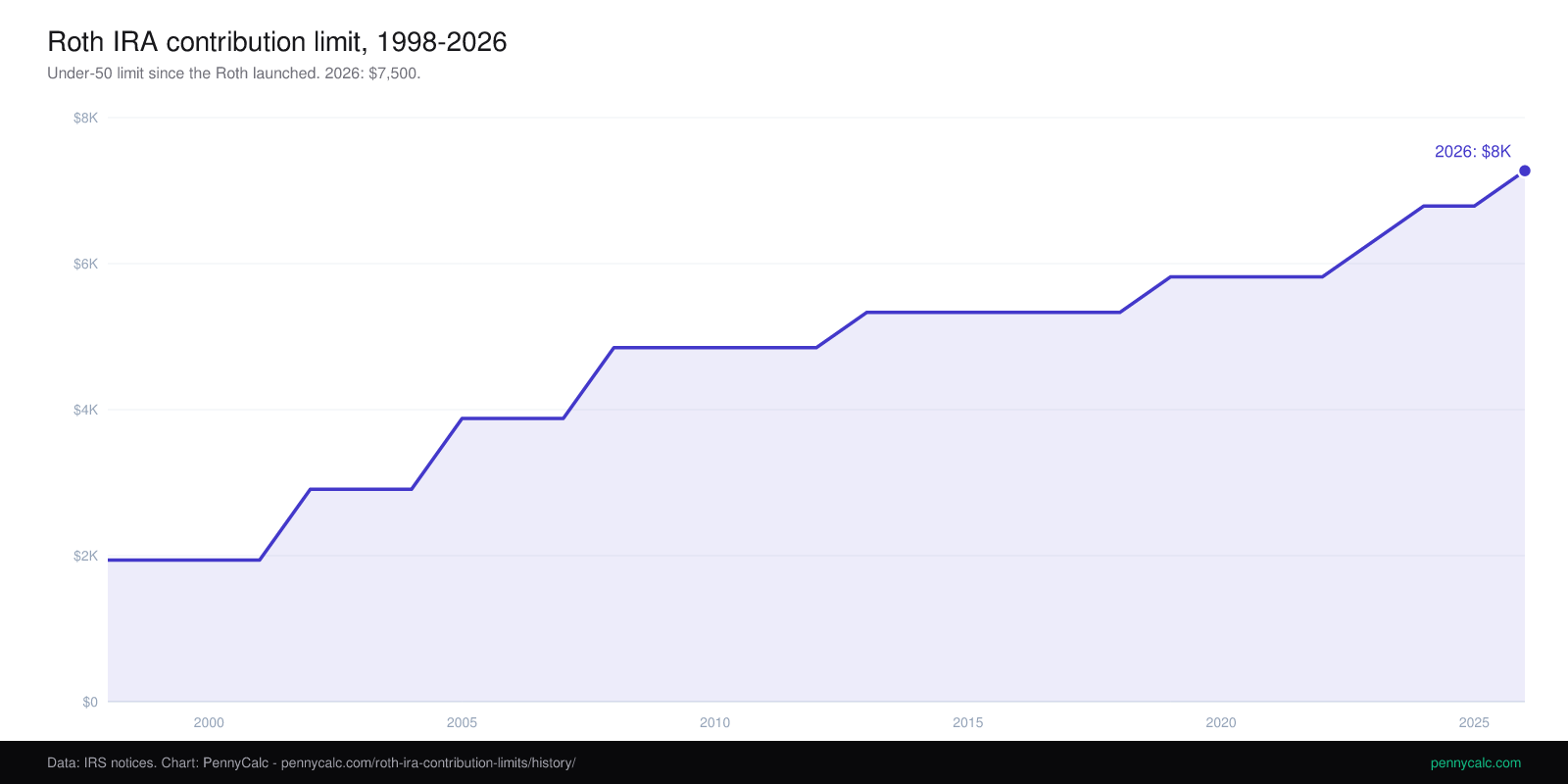
The 2026 Roth IRA contribution limit is $7,500 under age 50 and $8,600 at age 50 or older. The base limit started at $2,000 in 1998 and is shared across regular contributions to all Traditional and Roth IRAs.
Current figures: IRS Notice 2025-67. Rules and current guidance: IRS IRA contribution limits.
Recent Roth IRA contribution limits
The amounts below are the under-50 base limit. A person cannot contribute this amount separately to both a Roth and Traditional IRA; the annual cap is combined.
| Tax year | Under-50 limit | Change from prior year |
|---|---|---|
| 2026 | $7,500 | Up $500 |
| 2025 | $7,000 | No change |
| 2024 | $7,000 | Up $500 |
| 2023 | $6,500 | Up $500 |
| 2022 | $6,000 | No change |
| 2021 | $6,000 | No change |
| 2020 | $6,000 | No change |
| 2019 | $6,000 | Up $500 |
Swipe horizontally to explore the full timeline. Tap the chart to read an exact value.
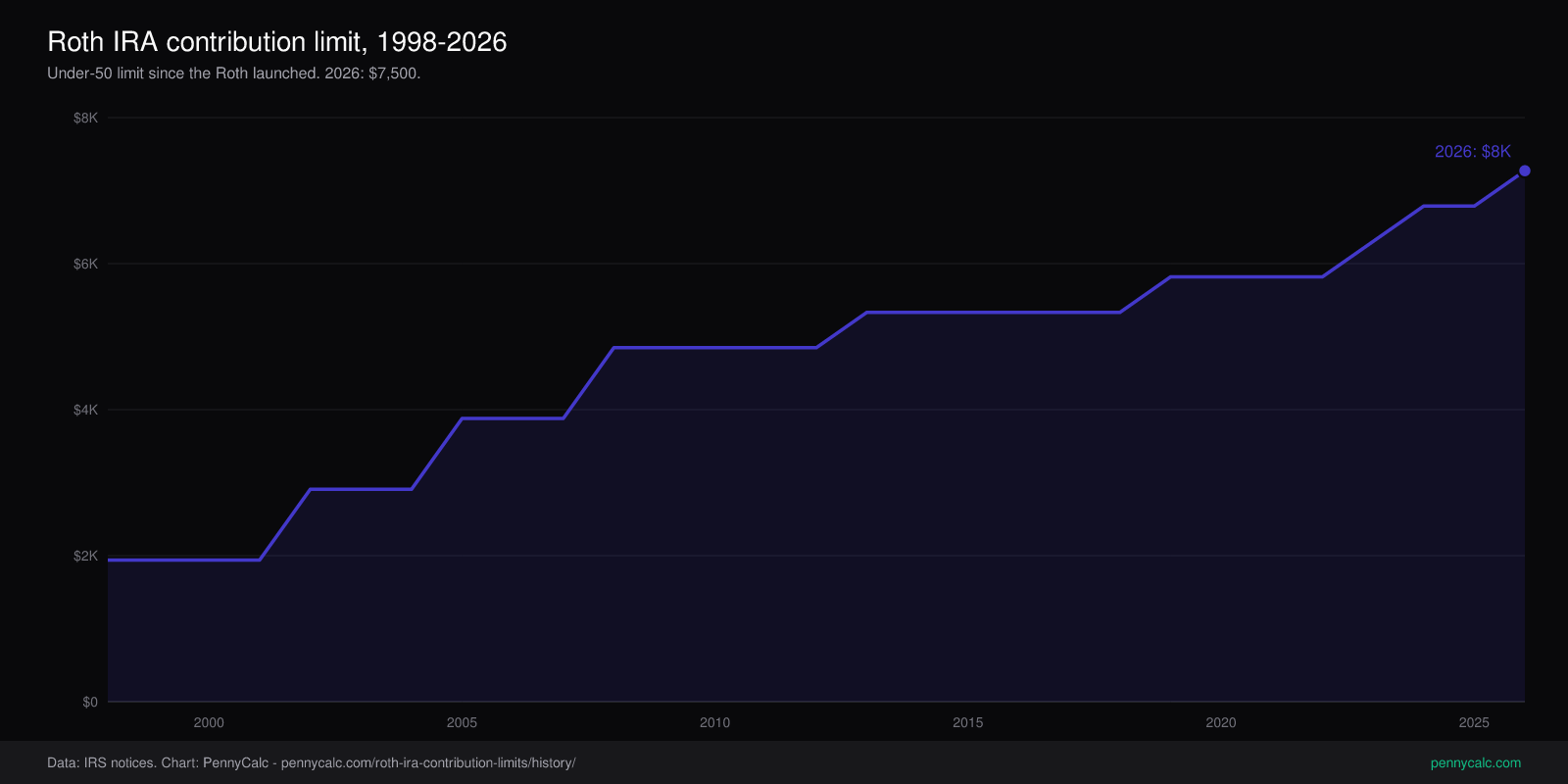
Download this chart: PNG light · PNG dark - PennyCalc chart artwork is reusable under CC BY 4.0 with attribution; source-data terms still apply. Licensing details.
The major changes
The Roth IRA has been shaped by four major pieces of legislation: TRA97 (origin), EGTRRA (acceleration), TIPRA 2006 (backdoor Roth), and SECURE 2.0 (cascading 2023+ changes).
Taxpayer Relief Act of 1997 creates the Roth IRA
The Roth IRA was authored by Senator William Roth (R-DE) and added to the Internal Revenue Code as Section 408A by the Taxpayer Relief Act of 1997. Effective January 1, 1998, the original limit was $2,000 for participants under age 50, with a $95,000 single / $150,000 MFJ phaseout for direct contributions. Contributions are not deductible. Earnings are tax-free when a distribution is qualified, which generally requires the five-tax-year period plus age 59.5, death, disability, or a qualifying first-home distribution.
EGTRRA - accelerated limit increases
EGTRRA scheduled stepwise IRA limit increases: $3,000 in 2002, $4,000 in 2005, and $5,000 in 2008, with inflation indexation thereafter. EGTRRA also created the age-50 catch-up, which began at $500 in 2002 and reached $1,000 by 2006. It stayed at $1,000 through 2025; SECURE 2.0 added inflation indexing starting in 2024, and the rounded amount first increased in 2026.
Pension Protection Act
The Pension Protection Act of 2006 made EGTRRA changes permanent (they were originally set to sunset in 2010). PPA also created the "qualified charitable distribution" (QCD) mechanism for IRAs at age 70.5+, which lets participants donate IRA dollars directly to a qualifying charity without the distribution counting as taxable income. The QCD is tied to the Required Minimum Distribution rules.
Roth conversion income limit removed
The 2006 Tax Increase Prevention and Reconciliation Act (TIPRA) repealed the $100,000 modified AGI limit on Roth conversions effective January 1, 2010. Before 2010, that income limit blocked many high earners from converting Traditional IRA balances to Roth. Its repeal enabled the modern "backdoor Roth" sequence: a nondeductible Traditional IRA contribution followed by a Roth conversion. Conversions can create taxable income, and the pro-rata rule applies across Traditional, SEP, and SIMPLE IRA balances.
TCJA eliminates Roth recharacterization
Before TCJA, a Roth conversion could be "recharacterized" (undone) by October 15 of the year following conversion if the converted assets had dropped in value. TCJA eliminated this option starting in 2018. Roth conversions are now one-way only: once you convert, the tax bill is fixed regardless of subsequent market movement. This made Roth conversion strategy more sensitive to market timing and made multi-step "convert in pieces over the year" strategies more important.
SECURE 2.0 - cascade of changes
SECURE 2.0 (signed late December 2022) made several Roth-relevant changes: the applicable RMD age is generally 73 for people born from 1951 through 1959 and 75 for people born in 1960 or later; SEP and SIMPLE IRAs may allow Roth contributions; eligible 529 assets can roll to a beneficiary's Roth IRA subject to a $35,000 lifetime cap and other limits; and the IRA age-50 catch-up became inflation-indexed. Roth IRA owners already had no lifetime RMDs; SECURE 2.0 removed lifetime RMDs from designated Roth workplace accounts beginning in 2024.
Where Roth IRA contribution limits stand today
The 2026 contribution limit is $7,500 for participants under age 50 ($8,600 with the $1,100 catch-up at 50+). Direct-contribution income phaseouts are $153,000 to $168,000 single and $242,000 to $252,000 MFJ for 2026 (IRS Notice 2025-67). Above the phaseout, a backdoor Roth may be available, subject to the pro-rata rule and Form 8606. Future limits should not be assumed before the IRS publishes them.
Things you might not know
- The annual limit is shared. The $7,500 2026 base limit covers combined regular contributions to Traditional and Roth IRAs; it is not a separate limit for each account type.
- Income limits apply differently. MAGI can reduce direct Roth contributions. Traditional IRA contributions do not have the same income ceiling, but their deduction may be limited by MAGI and workplace-plan coverage.
- Roth IRA owners have no lifetime RMDs. That rule predates SECURE 2.0. Beneficiaries of inherited Roth IRAs are still subject to inherited-account distribution rules.
- The IRA catch-up was frozen for almost two decades. It reached $1,000 in 2006 and stayed there through 2025. SECURE 2.0 added inflation indexing beginning in 2024, and the rounded catch-up first increased in 2026 to $1,100.
- Conversion rules can change through legislation. Current law has no MAGI ceiling on Roth conversions, but proposals have periodically sought to restrict nondeductible-contribution and conversion strategies. Future effective dates should not be assumed before legislation is enacted.
Roth IRA contribution limit by year
The under-50 Roth IRA contribution limit from the account's 1998 launch to 2026. Years not listed held the prior limit. The 2026 age-50 catch-up adds $1,100, and the limit is shared with the Traditional IRA.
| Year | Roth IRA limit | What changed that year |
|---|---|---|
| 1998 | $2,000 | Taxpayer Relief Act of 1997 creates the Roth IRA |
| 1999 | $2,000 | |
| 2000 | $2,000 | |
| 2001 | $2,000 | |
| 2002 | $3,000 | EGTRRA accelerates limit and creates catch-up |
| 2003 | $3,000 | |
| 2004 | $3,000 | |
| 2005 | $4,000 | |
| 2006 | $4,000 | |
| 2007 | $4,000 | |
| 2008 | $5,000 | Pension Protection Act makes EGTRRA permanent |
| 2009 | $5,000 | |
| 2010 | $5,000 | $100,000 income limit on Roth conversions removed |
| 2011 | $5,000 | |
| 2012 | $5,000 | |
| 2013 | $5,500 | |
| 2014 | $5,500 | |
| 2015 | $5,500 | |
| 2016 | $5,500 | |
| 2017 | $5,500 | |
| 2018 | $5,500 | TCJA eliminates Roth recharacterization (one-way only) |
| 2019 | $6,000 | |
| 2020 | $6,000 | |
| 2021 | $6,000 | |
| 2022 | $6,000 | |
| 2023 | $6,500 | SECURE 2.0 RMD age raised to 73, then 75 in 2033 |
| 2024 | $7,000 | |
| 2025 | $7,000 | |
| 2026 | $7,500 |
Full series shown. Scroll within the table to see every year.
Frequently Asked Questions
What is the 2026 Roth IRA contribution limit?
When was the Roth IRA created?
What was the most consequential Roth IRA legislative change?
What's the difference between the Roth IRA and Roth 401(k)?
How does the Roth IRA 5-year rule work?
Should I do a backdoor Roth in 2026?
To project your Roth balance against today's $7,500 limit and 2026 phaseout thresholds, use our Roth IRA calculator. To compare Roth against Traditional with apples-to-apples after-tax math, see Roth IRA vs Traditional IRA. For sources and update cadence, see our methodology.
Related tools and reading
Roth IRA Calculator
Project Roth balance with phaseout-aware contribution and 5-year rule logic.
Roth vs Traditional IRA
Side-by-side comparison with break-even rate and apples-to-apples math.
401(k) Calculator
Project 401(k) balance at retirement with employer match and 2026 IRS limits.
401(k) Limit History
Annual 401(k) employee deferral limit from 1987 to 2026.
IRA Contribution Limit History
The combined Traditional and Roth limit from 1974, including the 20-year freeze.