HSA Contribution Limit History
Facts verified: against 3 source-backed data records; page sources include IRS Rev. Proc. 2025-19; IRC § 223(b)(3)
Reviewed by Jessie for editorial clarity and sourcing. See more by Jessie.
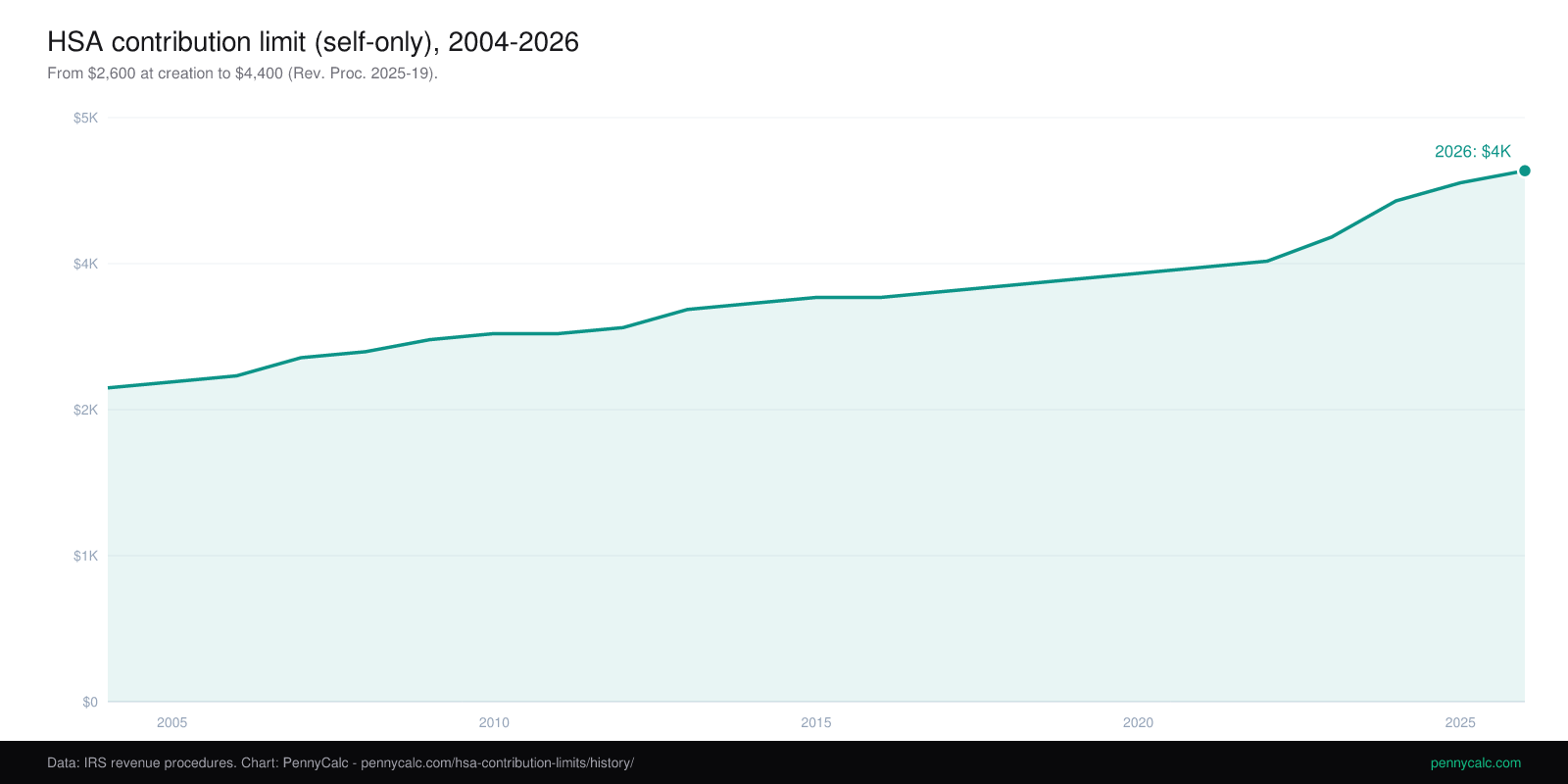
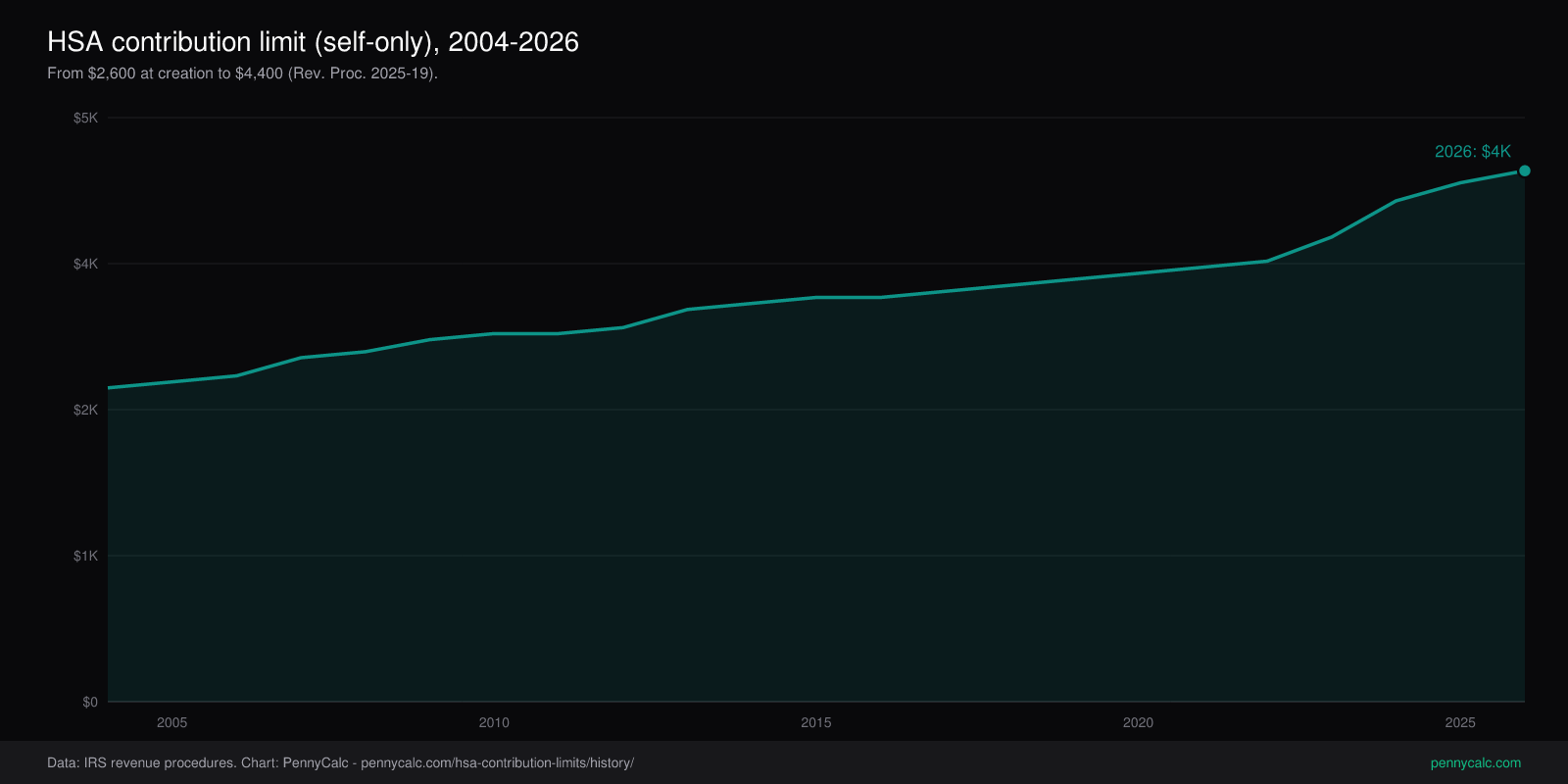
Annual HSA self-only contribution limit from the 2004 introduction ($2,600) through the 2026 figure of $4,400, with major legislative milestones annotated.
2026 annual contribution and HDHP thresholds: IRS Revenue Procedure 2025-19. Age-55 catch-up: Internal Revenue Code Section 223(b)(3); the statutory $1,000 amount is not inflation-indexed. Historical sources also include prior IRS Revenue Procedures, EBRI, and Devenir.
Swipe horizontally to explore the full timeline. Tap the chart to read an exact value.
Download this chart: PNG light · PNG dark - PennyCalc chart artwork is reusable under CC BY 4.0 with attribution; source-data terms still apply. Licensing details.
The major changes
The HSA has been shaped by four major pieces of legislation: MMA 2003 (origin), HCERA 2006 (flexibility), ACA 2010 (OTC restriction), and CARES 2020 (OTC reversal).
Medicare Modernization Act of 2003 creates the HSA
The Medicare Modernization Act (signed December 8, 2003) added Section 223 to the Internal Revenue Code, creating the Health Savings Account effective January 1, 2004. Eligibility required enrollment in a High-Deductible Health Plan (HDHP) and no other disqualifying health coverage. The original 2004 self-only contribution limit was $2,600 ($5,150 family), with a $500 catch-up for participants age 55+. HSAs replaced the more limited Medical Savings Accounts (MSAs) that had existed since 1996 in pilot form.
Tax Relief and Health Care Act expands flexibility
The Tax Relief and Health Care Act of 2006 made several HSA-friendly changes: allowed one-time IRA-to-HSA transfers, increased contribution limits to the maximum out-of-pocket allowed for HDHPs (eliminating the prior limitation that contributions could not exceed the deductible), and clarified that employer HSA contributions made through cafeteria plans are not subject to FICA. These changes drove the first big wave of HSA enrollment growth from roughly 1 million accounts in 2005 to 6 million by 2008 (EBRI HSA Database).
ACA restricts OTC drug reimbursement
The Affordable Care Act of 2010 included a provision restricting HSA (and FSA) reimbursement for over-the-counter drugs to those with a doctor's prescription, effective 2011. The change was unpopular - it forced participants to get prescriptions for things like aspirin to use HSA dollars. The ACA also raised the penalty for non-qualified HSA withdrawals from 10% to 20%. The OTC restriction lasted nearly a decade before being reversed.
CARES Act restores OTC drug reimbursement
The Coronavirus Aid, Relief, and Economic Security Act of March 2020 permanently restored HSA reimbursement for over-the-counter drugs without requiring a prescription, retroactive to January 1, 2020. The change applied to FSAs, HSAs, and HRAs. The CARES Act also added menstrual care products as qualifying medical expenses for HSA reimbursement, the first such expansion in nearly 20 years of HSA history.
Largest single-year increase
The 2024 HSA contribution limit jumped from $3,850 to $4,150 for self-only coverage (a $300 increase, the largest single-year step in HSA history). The 2024 family limit jumped from $7,750 to $8,300. The increase was driven by chained CPI adjustments that exceeded typical year-over-year growth, plus the inflation surge of 2022-2023 catching up in the lagging IRS adjustment formula.
Where HSA limits stand today
Revenue Procedure 2025-19 sets the 2026 HSA contribution limits at $4,400 self-only and $8,750 family. The separate age-55 catch-up is $1,000 under Internal Revenue Code Section 223(b)(3); it is statutory, not an indexed amount set by the Revenue Procedure. For 2026, an HSA-qualified HDHP must have a deductible of at least $1,700 self-only or $3,400 family, and its out-of-pocket ceiling cannot exceed $8,500 self-only or $17,000 family. HSA assets industry-wide reached approximately $137 billion in 2024 (Devenir HSA Research Report) across roughly 39 million accounts.
Things you might not know
- The HSA's 2024 industry asset total ($137B) doubled in just five years. Pandemic-era HDHP enrollment growth plus stronger investment uptake (more participants treating HSAs as long-term investment vehicles rather than spending accounts) drove the asset growth from roughly $66B at end of 2019 to $137B by end of 2024 (Devenir).
- You can reimburse yourself decades later. There's no time limit on HSA reimbursement: a $500 medical expense paid out-of-pocket today, with the receipt saved, can be reimbursed tax-free from your HSA in 2050 if you choose. The "shoe-box strategy" exploits this to convert the HSA into a multi-decade tax-free growth account while preserving access to the original contributions.
- Payroll HSA contributions can avoid FICA, while 401(k) deferrals don't. Traditional 401(k) deferrals reduce federal income-taxable income but not FICA wages. Eligible HSA contributions made through a qualifying cafeteria-plan payroll arrangement can reduce both. In an illustrative 22% federal bracket, a $4,400 payroll HSA contribution would reduce federal income tax by about $968 and employee FICA by about $337, or $1,305 combined, before state-tax effects.
- HSAs are portable; FSAs aren't. When you change jobs, HSA balances stay with you (it's your account at the bank, not the employer's). FSA balances generally don't carry over (use-it-or-lose-it, with limited exceptions). This is the core reason HSAs have grown 10x faster than FSAs over the past two decades.
- Some states tax HSA contributions and growth. California and New Jersey do not fully conform to federal HSA tax treatment. Check current state rules before assuming the federal tax treatment applies to a state return.
HSA self-only contribution limit by year
The self-only HSA contribution limit since Health Savings Accounts began in 2004. Family-coverage limits run roughly double. The separate $1,000 age-55 catch-up is statutory under IRC Section 223(b)(3), not part of the annually indexed series.
| Year | HSA self-only limit | What changed that year |
|---|---|---|
| 2004 | $2,600 | Medicare Modernization Act of 2003 creates the HSA |
| 2005 | $2,650 | |
| 2006 | $2,700 | |
| 2007 | $2,850 | Tax Relief and Health Care Act expands HSA flexibility |
| 2008 | $2,900 | |
| 2009 | $3,000 | |
| 2010 | $3,050 | |
| 2011 | $3,050 | ACA prohibits HSA reimbursement for OTC drugs (later reversed) |
| 2012 | $3,100 | |
| 2013 | $3,250 | |
| 2014 | $3,300 | |
| 2015 | $3,350 | |
| 2016 | $3,350 | |
| 2017 | $3,400 | |
| 2018 | $3,450 | |
| 2019 | $3,500 | |
| 2020 | $3,550 | CARES Act re-allows OTC drug reimbursement permanently |
| 2021 | $3,600 | |
| 2022 | $3,650 | |
| 2023 | $3,850 | |
| 2024 | $4,150 | IRS announces largest single-year increase ($300) |
| 2025 | $4,300 | |
| 2026 | $4,400 |
Full series shown. Scroll within the table to see every year.
Frequently Asked Questions
What is the 2026 HSA contribution limit?
When did HSAs start?
Why is the HSA called the 'triple tax advantage' account?
Can I use HSA dollars for non-medical expenses after age 65?
What's the 'shoe-box strategy' for HSAs?
Can I contribute to an HSA if I'm on Medicare?
To see your tax savings from maxing the HSA against your bracket, use our tax bracket calculator. To project your HSA balance compounded over time, treat it like a 401(k) and use the 401(k) calculator with HSA contribution amounts. For sources and update cadence, see our methodology.
Related tools and reading
Paycheck Calculator
See how HSA contributions reduce federal tax and FICA in your paycheck.
Retirement Calculator
Project savings including HSA balance with Social Security offsets.
401(k) Calculator
Compare HSA priority vs 401(k) contributions for high-deductible-plan enrollees.
401(k) Limit History
Annual 401(k) employee deferral limit from 1987 to 2026.