Medicare IRMAA Surcharge History
Facts verified: against 1 source-backed data record; page sources include CMS final 2026 Part B and Part D IRMAA tables + historical CMS premium notices
Reviewed by Josh for financial modeling and data. See more by Josh.
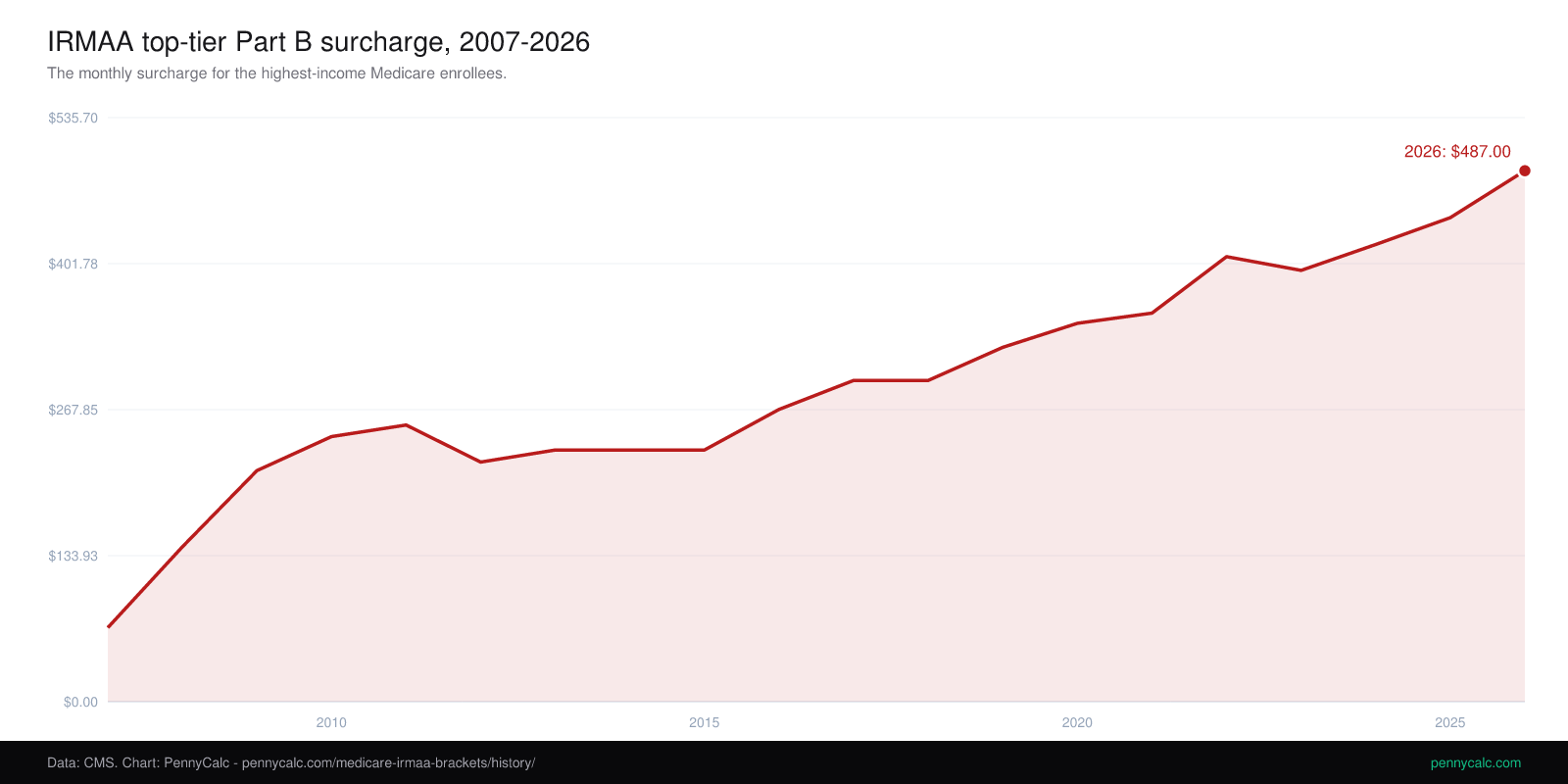
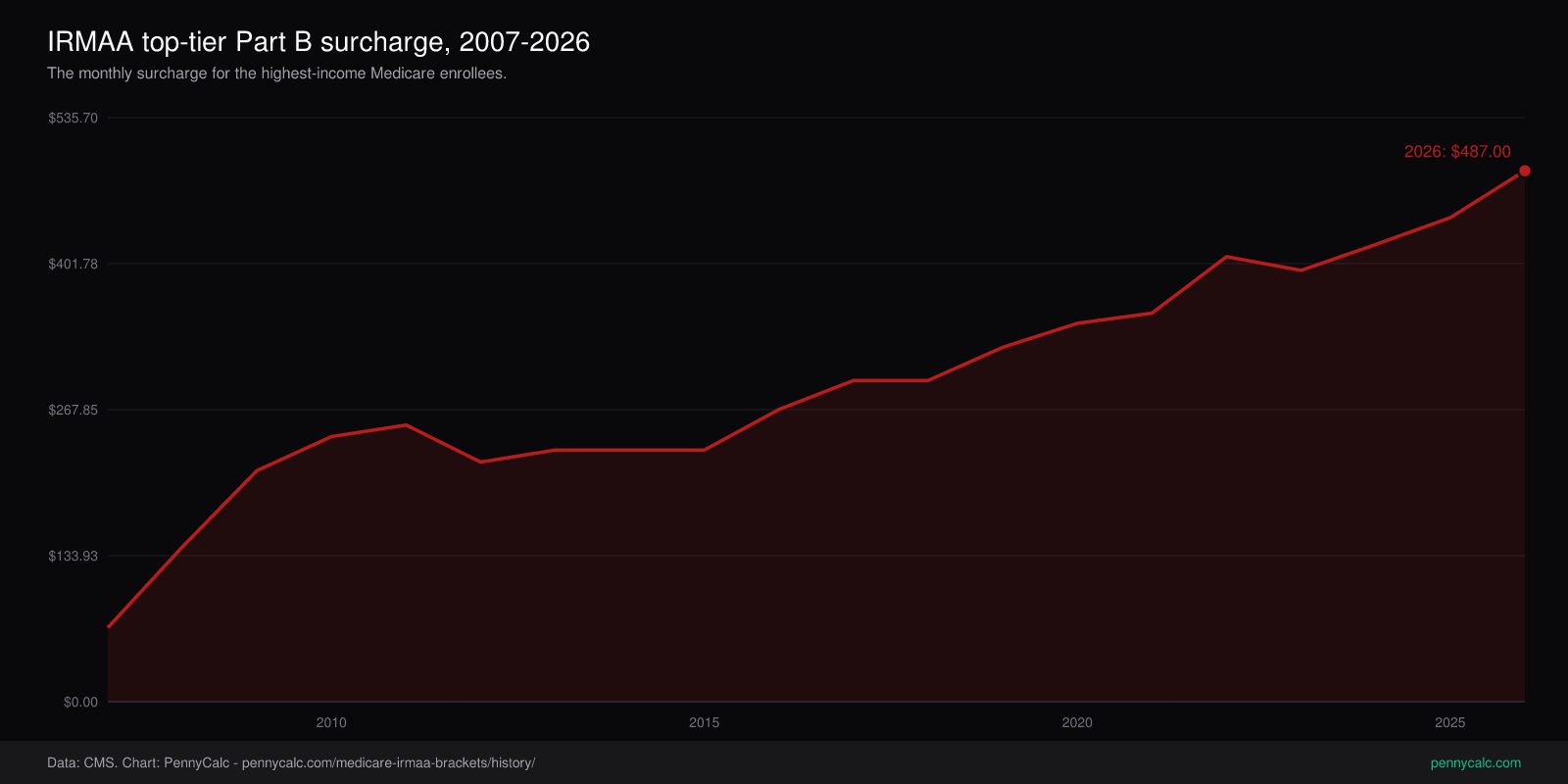
IRMAA top-tier Medicare Part B monthly surcharge from $67.90 in 2007 to $487.00 in 2026, with major Medicare legislation annotated.
Sources: CMS annual Medicare Part B premium notices, Federal Register, SSA Form SSA-44 documentation, Medicare Modernization Act of 2003 legislative history.
Swipe horizontally to explore the full timeline. Tap the chart to read an exact value.
Download this chart: PNG light · PNG dark - PennyCalc chart artwork is reusable under CC BY 4.0 with attribution; source-data terms still apply. Licensing details.
The major changes
IRMAA has been shaped by three major changes since its 2007 introduction: ACA Part D extension, BBA 2018 top-tier creation, and the 2020 start of inflation indexation.
Medicare Modernization Act creates IRMAA
The Medicare Modernization Act of 2003 added income-related premium adjustments to Medicare Part B starting in 2007. The highest 2007 income-related adjustment was $67.90/month; added to the $93.50 standard premium, it produced a $161.40 total Part B premium. The adjustment was phased in from 2007 through 2009.
Affordable Care Act extends IRMAA to Part D
The ACA of 2010 extended the income-related surcharge to Medicare Part D (prescription drug coverage), effective 2011. Part D uses the same MAGI tiers but separate dollar adjustments. At the top 2026 tier, Part D IRMAA is $91.00 per month in addition to the selected plan premium.
Bipartisan Budget Act adds new top tier
Before 2019, the highest Part B IRMAA surcharge was $294.60 per month in 2018. The Bipartisan Budget Act of 2018 added a new top tier at MAGI of $500,000 single / $750,000 MFJ, effective 2019. The new tier carried a $325.00 surcharge and a $460.50 total Part B premium in 2019.
MAGI thresholds frozen for 12 years
The original 2007 IRMAA MAGI thresholds ($80K single / $160K MFJ for the first surcharge tier) were not inflation-indexed. From 2007 through 2019, the thresholds stayed flat in nominal dollars while wages and inflation grew, which silently pulled more retirees into IRMAA territory each year. Roughly 5% of Medicare beneficiaries paid IRMAA in 2007; by 2019 that share was approximately 8%. Indexation began in 2020.
Inflation indexation begins
Starting in 2020, IRMAA MAGI thresholds were indexed to chained CPI (the same indexation method used for tax brackets after TCJA). This slowed the rate at which retirees were pulled into IRMAA but did not reverse the 12 years of bracket creep that preceded indexation. The 2026 first-tier threshold is approximately $109,000 single / $218,000 MFJ (vs. the original $80K / $160K from 2007).
Standard premium decreases and IRMAA follows
The standard Medicare Part B premium decreased from $170.10 in 2022 to $164.90 in 2023, driven partly by the unwind of the Aduhelm-related contingency reserve. The top-tier IRMAA surcharge fell from $408.20/month in 2022 to $395.60/month in 2023; total top-tier Part B fell from $578.30 to $560.50.
Where IRMAA stands today
CMS set the 2026 standard Part B premium at $202.90. The top-tier Part B IRMAA surcharge is $487.00/month, bringing total Part B to $689.90 per person. Top-tier Part D IRMAA is another $91.00 plus the plan premium. The 2026 determination generally uses 2024 MAGI.
Things you might not know
- IRMAA is a cliff, not a slope. Unlike marginal income-tax brackets, crossing an IRMAA threshold changes the full monthly adjustment for that tier. Depending on the tier and whether one or two spouses are enrolled, one dollar of additional MAGI can add hundreds or more than a thousand dollars of annual premiums.
- The MAGI thresholds were frozen for 12 years. The original 2007 thresholds ($80K single / $160K MFJ) stayed static through 2019, silently pulling more retirees into IRMAA each year. Indexation began in 2020 but the bracket creep from 2007-2019 was never reversed.
- Roth conversions can trigger IRMAA two years later. A large Roth conversion in 2024 increases your 2024 MAGI, which determines your 2026 IRMAA. Many financial planners specifically time conversions to avoid the 2-year-back IRMAA effect, particularly around age 63 (the last year before the Medicare-enrollment lookback).
- Married couples can pay two surcharges. If both spouses are enrolled in Medicare and joint MAGI reaches the top tier, each pays the adjustment. In 2026 that is $974.00 per month in combined Part B IRMAA, plus $182.00 in combined Part D IRMAA.
- SSA Form SSA-44 can reduce IRMAA after a life-changing event. If retirement, work stoppage, divorce, marriage, death of a spouse, or another defined event reduced income, an enrollee can request a new initial determination using Form SSA-44 and supporting documentation.
Top-tier IRMAA Part B surcharge by year
The highest-tier monthly Part B surcharge since IRMAA began in 2007, paid on top of the standard premium by the highest-income enrollees. Years not listed held close to the prior surcharge.
| Year | Top-tier monthly surcharge | What changed that year |
|---|---|---|
| 2007 | $67.90 | IRMAA Part B surcharge begins (MMA 2003) |
| 2008 | $142.00 | |
| 2009 | $211.90 | |
| 2010 | $243.10 | |
| 2011 | $253.70 | ACA adds IRMAA surcharge to Part D prescription coverage |
| 2012 | $219.80 | |
| 2013 | $230.80 | |
| 2014 | $230.80 | |
| 2015 | $230.80 | |
| 2016 | $268.00 | |
| 2017 | $294.60 | |
| 2018 | $294.60 | Bipartisan Budget Act adds new top tier (MAGI > $500K) |
| 2019 | $325.00 | |
| 2020 | $347.00 | MAGI thresholds inflation-indexed (frozen 2007-2019) |
| 2021 | $356.40 | |
| 2022 | $408.20 | |
| 2023 | $395.60 | Standard Part B premium decreases from 2022 inflation overshoot |
| 2024 | $419.30 | |
| 2025 | $443.90 | |
| 2026 | $487.00 | CMS sets the top Part B IRMAA surcharge at $487.00 per month |
Full series shown. Scroll within the table to see every year.
Frequently Asked Questions
What is IRMAA?
What are the 2026 IRMAA brackets?
How does the 2-year MAGI lookback affect IRMAA?
Is IRMAA a tax cliff or progressive?
How can I avoid IRMAA?
Are there proposals to expand IRMAA?
To estimate retirement spending coverage after Social Security, use our retirement calculator. It does not calculate MAGI or IRMAA. Use the tax bracket calculator for federal income tax, then compare taxable-income decisions separately with the IRMAA thresholds above. For the wage-base side of Medicare and Social Security, see Social Security wage base history. For sources and update cadence, see our methodology.
Related tools and reading
Retirement Calculator
Estimate retirement spending coverage after Social Security; does not calculate MAGI or IRMAA.
Roth IRA Calculator
Project Roth contribution growth and compare after-tax outcomes with a Traditional IRA.
Capital Gains Tax Calculator
Estimate federal capital gains tax, then compare resulting MAGI separately with the IRMAA thresholds.
Medicare Premium History
The full standard Part B premium since 1966, with all five IRMAA tiers explained.
Social Security COLA History
The annual raise that partly offsets rising Part B premiums.
Social Security Wage Base History
SSA contribution and benefit base from 1937 to 2026.