30-Year Mortgage Rate History by Year
Facts verified: against 1 source-backed data record; page sources include Freddie Mac PMMS through October 1, 2026
Reviewed by Michael for implementation and test coverage. See more by Michael.
The latest Freddie Mac 30-year fixed rate is 7.28% as of October 1, 2026. The 2026 year-to-date average is 6.43%; the table and chart below cover annual averages from 1972 through 2025 and label the partial 2026 period separately.
Official sources: Freddie Mac PMMS, 30-year FRED series, and 15-year FRED series.
Historical mortgage rates at a glance
In the PMMS series, the 30-year rate reached a weekly high of 18.63% in 1981 and a weekly low of 2.65% in 2021. Those single-week records are different from the annual averages shown in the year table.
Latest week
7.28%
30-year fixed on October 1, 2026
2026 YTD average
6.43%
39 weekly readings through October 1, 2026
Weekly record high
18.63%
October 9, 1981
Weekly record low
2.65%
January 7, 2021
| Year | Average rate | Coverage |
|---|---|---|
| 2026 | 6.43% | YTD through October 1, 2026 |
| 2025 | 6.60% | Full calendar year |
| 2024 | 6.72% | Full calendar year |
| 2023 | 6.81% | Full calendar year |
| 2022 | 5.34% | Full calendar year |
| 2021 | 2.96% | Full calendar year |
| 2020 | 3.11% | Full calendar year |
Swipe horizontally to explore the full timeline. Tap the chart to read an exact value.
Download this chart: PNG light · PNG dark - PennyCalc chart artwork is reusable under CC BY 4.0 with attribution; source-data terms still apply. Licensing details.
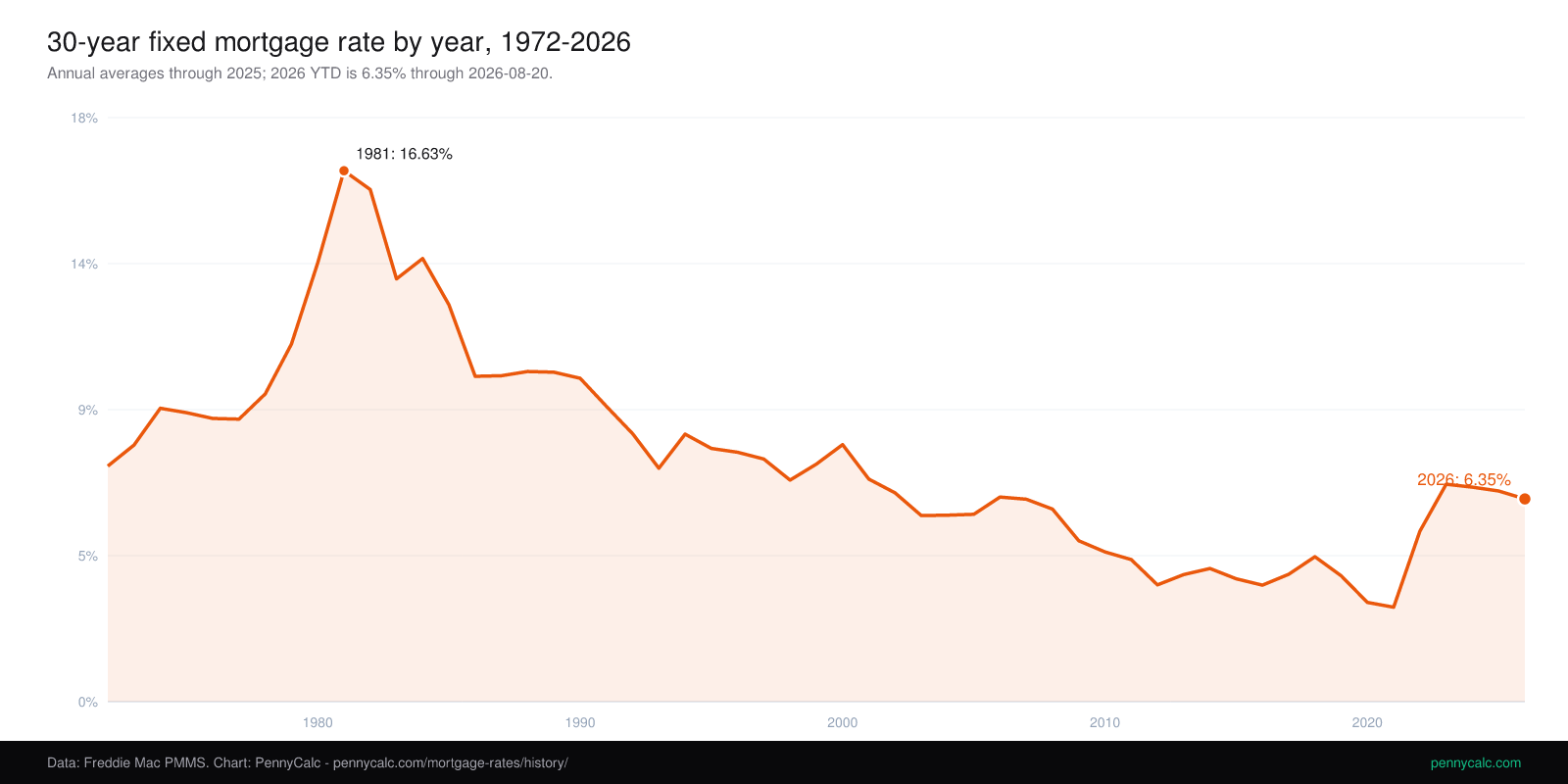
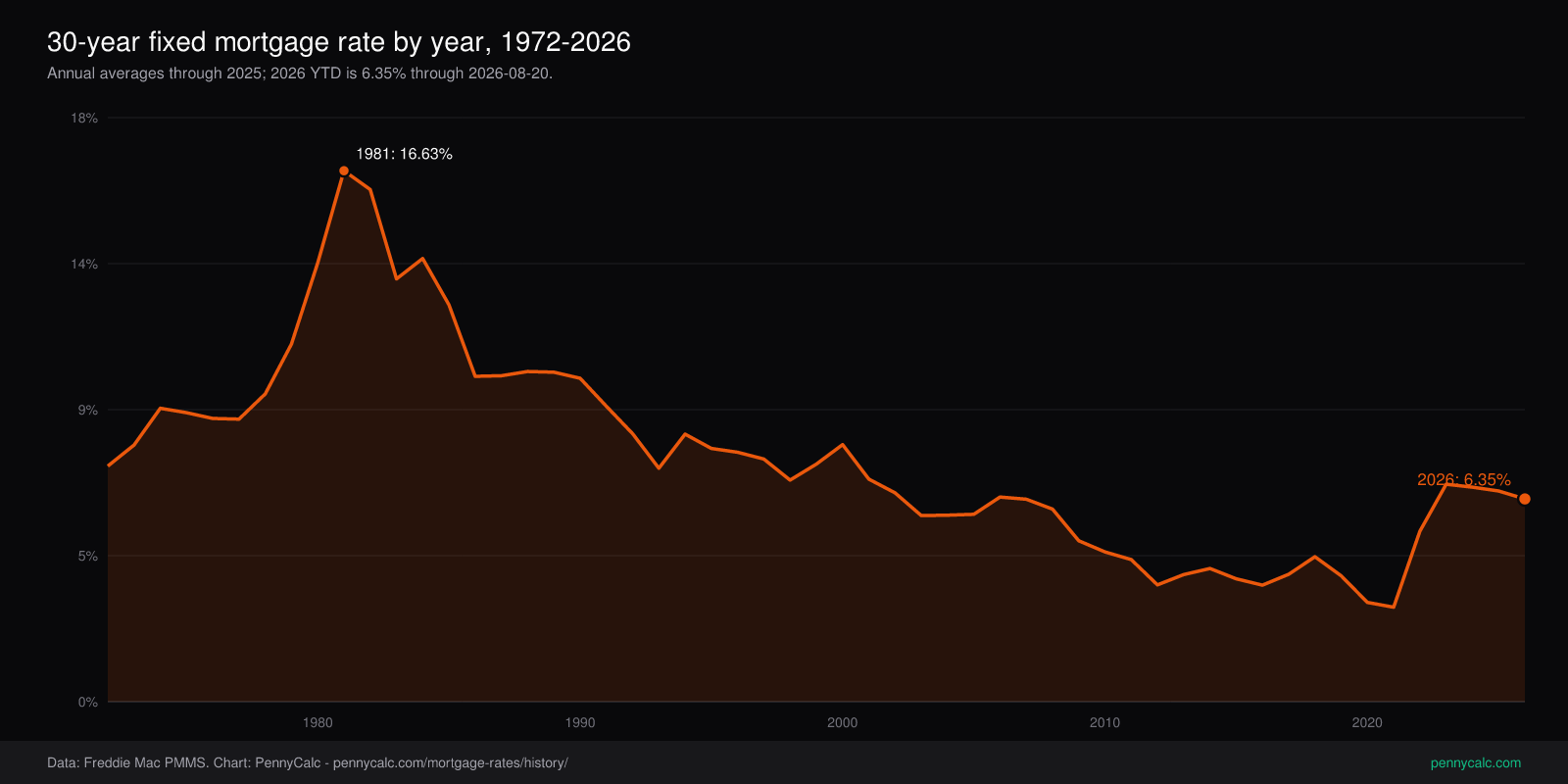
The chart's 2026 point is the YTD average (6.43%), not the latest weekly reading (7.28%).
Explore mortgage rates by timeframe
Switch between the official 30-year and 15-year series, then view annual, monthly, or weekly data.
| Period | Rate |
|---|
What drove mortgage rates over time?
Mortgage rates respond to longer-term Treasury yields, inflation expectations, monetary policy, and mortgage-backed-security spreads. The PMMS series supplies a consistent long-run benchmark, but it is not a personalized lender quote.
Inflation and the record peak
The first full-year PMMS average was 7.38% in 1972. Inflation, oil shocks, and tight monetary policy then pushed the 1981 annual average to 16.63%. The weekly series reached its record 18.63% on October 9, 1981.
A long disinflationary decline
As inflation expectations receded, the annual average fell from 16.04% in 1982 to 6.34% in 2007. The path was uneven, but each major cycle generally produced lower rate peaks and troughs.
Financial crisis and quantitative easing
The Federal Reserve cut short-term rates and purchased mortgage-backed securities after the financial crisis. The 30-year annual average fell below 5% in 2010 and remained below 5% through 2021.
Pandemic-era record low
Emergency monetary policy and mortgage-backed-security purchases pushed the weekly PMMS rate to its record low of 2.65% on January 7, 2021. The full-year 2021 average was 2.96%.
The inflation reset
The annual average jumped to 5.34% in 2022 and 6.81% in 2023 as inflation and Treasury yields rose. It averaged 6.72% in 2024 and 6.60% in 2025. Through October 1, 2026, the 2026 YTD average is 6.43%; the latest weekly reading is 7.28%.
Sources and methodology
Weekly observations come from Freddie Mac's Primary Mortgage Market Survey as distributed by FRED. The 30-year annual series uses Freddie Mac's published annual averages through 2024; we calculate 2025 and 2026 from the official weekly observations. Monthly values and the 15-year annual series are arithmetic means of weekly observations in each calendar period. The 2026 value is YTD through October 1, 2026; it is not a forecast or completed-year average.
Freddie Mac changed the PMMS collection method on November 17, 2022, moving from a lender survey to mortgage application data submitted through Loan Product Advisor. That methodology break matters when comparing periods. Read the official PMMS methodology.
Download the mortgage-rate history data
Each file includes both 30-year and 15-year fixed rates where the official series is available.
More granular CSV files
30-year fixed mortgage rate by year
Calendar-year averages from 1972 through 2025. The 2026 row is the YTD average through October 1, 2026; the separate latest weekly rate is 7.28%.
| Year | Average rate | What changed that year |
|---|---|---|
| 1972 | 7.38% | Freddie Mac PMMS survey begins (1971) |
| 1973 | 8.04% | |
| 1974 | 9.19% | |
| 1975 | 9.05% | |
| 1976 | 8.87% | |
| 1977 | 8.85% | |
| 1978 | 9.64% | |
| 1979 | 11.2% | Volcker named Fed Chair, begins inflation fight |
| 1980 | 13.74% | |
| 1981 | 16.63% | Modern peak: 16.63% annual average |
| 1982 | 16.04% | |
| 1983 | 13.24% | |
| 1984 | 13.88% | |
| 1985 | 12.43% | |
| 1986 | 10.19% | Tax Reform Act of 1986 - mortgage interest deduction preserved |
| 1987 | 10.21% | |
| 1988 | 10.34% | |
| 1989 | 10.32% | |
| 1990 | 10.13% | |
| 1991 | 9.25% | |
| 1992 | 8.39% | |
| 1993 | 7.31% | |
| 1994 | 8.38% | |
| 1995 | 7.93% | |
| 1996 | 7.81% | |
| 1997 | 7.6% | |
| 1998 | 6.94% | |
| 1999 | 7.44% | |
| 2000 | 8.05% | |
| 2001 | 6.97% | |
| 2002 | 6.54% | |
| 2003 | 5.83% | |
| 2004 | 5.84% | |
| 2005 | 5.87% | |
| 2006 | 6.41% | |
| 2007 | 6.34% | |
| 2008 | 6.03% | Financial crisis - Fed cuts rates to zero |
| 2009 | 5.04% | |
| 2010 | 4.69% | |
| 2011 | 4.45% | |
| 2012 | 3.66% | |
| 2013 | 3.98% | |
| 2014 | 4.17% | |
| 2015 | 3.85% | |
| 2016 | 3.65% | |
| 2017 | 3.99% | |
| 2018 | 4.54% | |
| 2019 | 3.94% | |
| 2020 | 3.11% | Pandemic-era Fed action drives rates to record lows |
| 2021 | 2.96% | Modern low: 2.96% annual average |
| 2022 | 5.34% | Fed begins aggressive tightening to fight inflation |
| 2023 | 6.81% | |
| 2024 | 6.72% | |
| 2025 | 6.6% | |
| 2026 | 6.43% | Year-to-date average through October 1, 2026; latest weekly reading 7.28% |
Full series shown. Scroll within the table to see every year.
Mean of completed annual averages, 1972-2025: 7.7%. This is historical context, not a prediction or borrower-specific quote.
Frequently Asked Questions
What was the highest 30-year mortgage rate in U.S. history?
What was the lowest 30-year mortgage rate ever?
What is the average mortgage rate in 2026?
How are the yearly and monthly mortgage rates calculated?
How does the 15-year fixed rate compare with the 30-year rate?
Why did mortgage rates rise so quickly in 2022?
Run a purchase scenario in the mortgage payment calculator, or estimate a budget with the home affordability calculator.
Related tools and reading
Mortgage Calculator
Calculate monthly payment, total interest, and amortization at any rate.
Home Affordability Calculator
Use income and debt ratios to estimate a home-price range.
U.S. Home Price History
Compare the national median home price with the rate environment by year.
State Tax & Housing Comparison
Compare property tax and income tax across all 50 states.