Choose the medical coverage before comparing the price
Start with the care you want access to. Check your doctors, hospitals, specialists and mental health providers against each plan’s network, then check your medications against its formulary. Two plans with similar names can cover the same care on very different terms. A lower annual cost is useful only if the coverage works for you.
Once you have that foundation, the cost terms become easier to place. Your employee premium keeps the coverage in place. The deductible is what you pay for services subject to it before the plan begins sharing those costs. A copay is a set amount for a covered service, while coinsurance is your percentage of the bill. Check each service’s rules, since a copay may apply before or after the deductible.
The out-of-pocket limit puts a ceiling on the covered costs that count toward it. You still pay premiums, and noncovered care and many out-of-network charges fall outside that ceiling. That distinction matters when you’re working out how much cash a difficult medical year could require. HealthCare.gov explains which costs count.
For families, who needs the care can change the bill
With an embedded deductible, one person can reach an individual deductible before the family meets its combined threshold. With an aggregate deductible, the family generally has to meet the family deductible first. The individual and family out-of-pocket limits are a separate set of thresholds. As a result, one person’s large bill can leave you paying a different amount from the same total spread across the family.
You can test both patterns in the plan comparer. Enter the thresholds from your documents, then see what changes when care is concentrated in one person or spread across the household.
Use the accounts to help pay your share
Once you understand what the medical plan covers, look at how an HSA, FSA or HRA could help pay your remaining expenses. The differences are practical: who funds the account, whether the money belongs to you, and whether you can keep using it after the year ends or you leave the job.
| Account | Funding and eligibility | What happens to unused money? |
|---|---|---|
| HSA | You, your employer or both can contribute if you meet the eligibility rules. Employer deposits count toward the applicable contribution limit. | The balance stays in your account. It is portable when you change jobs. |
| Health FSA | An employer-established arrangement. You elect salary reductions for eligible expenses; employer contributions may also be available. | Generally use it or lose it, subject to an employer-permitted carryover or grace period. Check your own plan’s terms. |
| HRA | An employer-funded arrangement reimbursing eligible costs according to the plan. You do not make salary-reduction contributions to an HRA. | Carryover and continued access depend on the arrangement. An unused allowance is not automatically a personal asset. |
Check eligibility before counting on the tax benefits. A general-purpose FSA or HRA that can reimburse your medical expenses can affect your ability to contribute to an HSA, including coverage through a spouse. Limited-purpose and certain other arrangements can work differently. The IRS account guide walks through the rules and exceptions.
Keep the deposit and the tax benefit separate
Your own HSA contribution moves money into an account you own. The deposit itself is still your asset; the reduction in taxes is the saving. An employer HSA contribution adds a separate benefit. Keeping those pieces distinct gives you a cleaner comparison and avoids crediting the same dollar twice.
With a health FSA, start from the expenses you reasonably expect to have. The tax benefit can be reduced or wiped out if you forfeit unused funds. Our calculator uses the FSA against modeled medical costs only, so you’ll need to consider any additional eligible dental or vision expenses separately.
Give the extras their own decision
Employers may bundle services into the medical plan, pay for a benefit automatically, or offer it as an optional purchase. Use the list below to work through your enrollment materials. For each item, ask what you already receive, what you would pay to add it, and when you would actually use it.
| Benefit category | What it can add | What to check |
|---|---|---|
| Dental and vision | Coverage for specified dental or vision services. | Separate premiums, networks, annual limits, waiting periods and dependent coverage. Try the cost examples. |
| Employee assistance | Counseling, referrals or other assistance services. | Who can use it, session or service limits, and how it connects to medical mental health coverage. |
| Telehealth and care navigation | Virtual visits, help finding providers or support understanding bills. | Access fees, covered services, participating providers and whether the service is already part of the medical plan. |
| Wellness and family-building support | Employer-specific programs or reimbursements. | Eligibility, approvals, reimbursement limits, exclusions and any tax treatment. |
| Disability and life insurance | Income or beneficiary protection after a qualifying event. | Benefit amount, waiting period, exclusions, employer-paid versus optional coverage and portability. |
| Accident, critical illness and hospital indemnity | Specified payments after events defined by the policy. | Covered triggers, benefit schedule and additional premiums. These policies do not replace comprehensive medical coverage. |
These benefits can add value, but they each have their own terms. The medical-plan comparer handles medical cost sharing and the supported spending accounts. Keep a separate list of the other elections so you can see what they add to your total benefits bill.
Are dental and vision benefits worth the extra premium?
For dental and vision, start with the services you expect to use. Add your employee premium to the bills you would still pay under the plan, then compare that total with paying for the same care yourself. Use the prices available to you in each case, since a network discount can matter as much as a stated allowance.
One person / One year / Fictional illustrations
Start with the services you expect to use
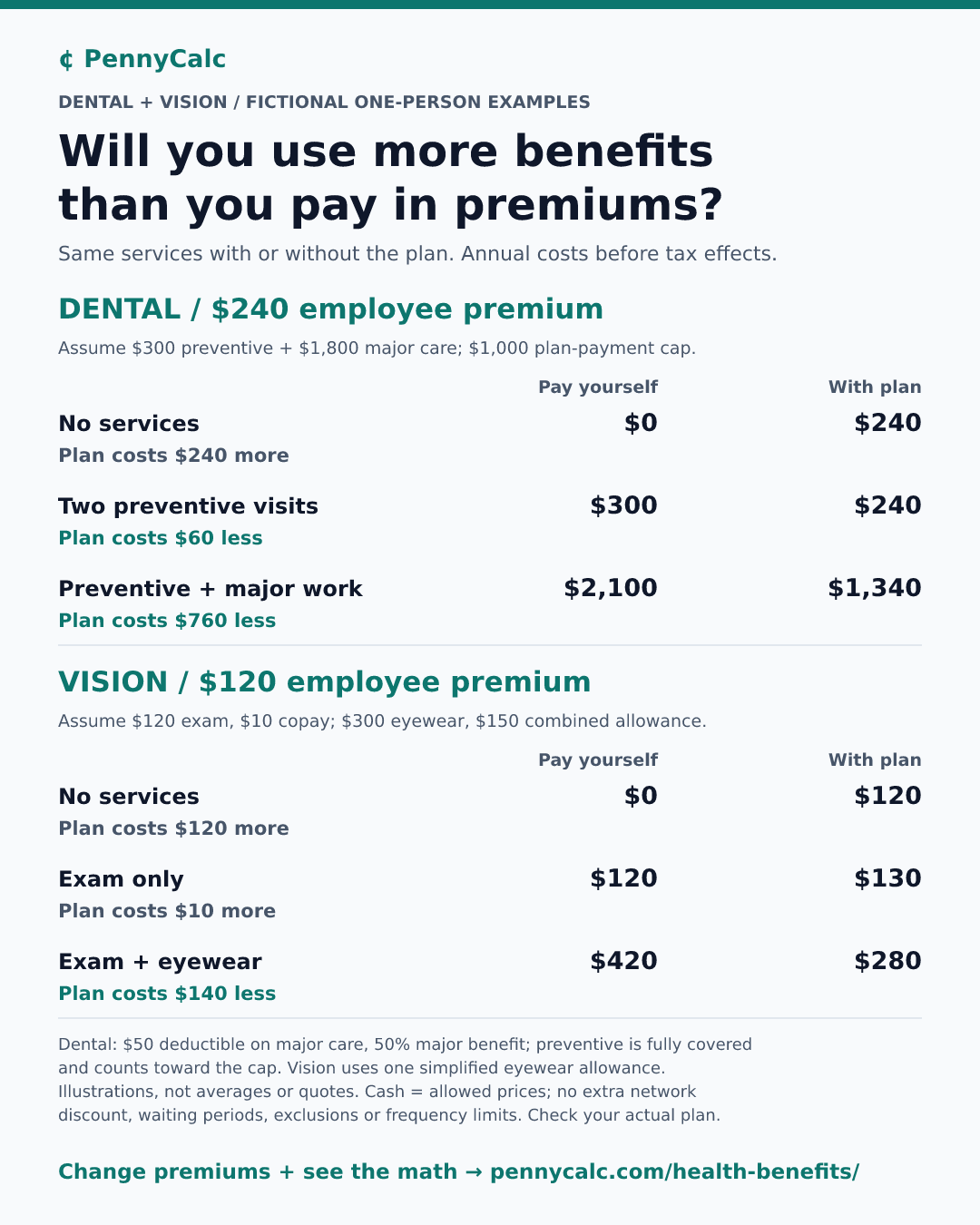
These fictional examples show the same person getting the same care with and without a plan. Change the employee premium to see how much the choice depends on what you pay for coverage. The examples illustrate the calculation; they are not national averages, quotes or a forecast of your care.
Only the premium is editable here. For your own plan, also check its prices, deductible, benefit percentage and annual payment limit against these fictional assumptions.
Dental
Assume $300 preventive care, $1,800 major work, a $50 deductible, 50% major coverage and a $1,000 annual plan-payment cap. Preventive care is fully covered and counts toward this cap.
Pay yourself $0With plan $240
Plan costs $240 morePay yourself $300With plan $240
Plan costs $60 lessPay yourself $2,100With plan $1,340
Plan costs $760 lessVision
Assume a $120 exam with a $10 copay, $300 eyewear and a $150 combined eyewear allowance. Real plans may treat frames, lenses and contacts separately.
Pay yourself $0With plan $120
Plan costs $120 morePay yourself $120With plan $130
Plan costs $10 morePay yourself $420With plan $280
Plan costs $140 lessWhat makes the plan worthwhile? For the year’s care to cost less, the plan payments and discounts you actually use need to exceed your employee premium. Pay particular attention to a dental benefit maximum: it limits what the plan pays. That works in the opposite direction from a medical out-of-pocket maximum, which limits specified costs you pay.
The examples use the same cash and covered allowed prices, with no extra network discount or tax effects. They leave out waiting periods, exclusions, treatment limits and noncovered upgrades, all of which are worth checking in your own plan. Enter only your employee share of the premium. These costs are separate from the medical-plan calculator.
· Download dental/vision graphic · Example calculations (CSV)
How the examples work and what to check
Dental: the preventive benefit is $300. The major-work benefit before the cap is ($1,800 − $50) × 50% = $875, but only $700 of this example’s $1,000 cap remains after preventive care. Total plan payments are therefore $1,000; $2,100 care − $1,000 plan payments + your premium gives your annual cost. Some real plans exclude preventive care from their cap or have no cap; this example does neither.
Vision: the exam benefit is $120 − $10 = $110. The simplified eyewear benefit is the smaller of the $300 price and $150 allowance. Together the plan pays $260. Check whether a real allowance is for frames, lenses, contacts or a combination, and whether it refreshes every year or every two years.
Read an actual employer dental guide for examples of maximums and preventive-care exceptions, and an actual vision brochure for allowances, copays and frequency limits. Our fictional prices, premiums and terms do not reproduce either plan. Sources checked October 27, 2026.
Before making the election, check the provider network, waiting periods, excluded treatment and any annual or lifetime payout limits. The worksheet uses your employee premium, so leave out the share your employer pays. Keep dental and vision separate from the medical estimate, especially if you plan to use an FSA or HSA to help pay for them, so each cost and account benefit is counted once.
Use the right year’s limits
Open enrollment often asks you to choose next year’s benefits while you’re still using this year’s plan. Match the limit to the year you’re planning for. We use the same source-checked benefit data in this guide and the calculator, with announced next-year HSA limits kept separate from current-year limits.
| Parameter | 2026 | 2027 |
|---|---|---|
| HSA contribution, self-only | $4,400 | $4,500 |
| HSA contribution, family | $8,750 | $9,000 |
| Eligible age-55 catch-up | $1,000 | $1,000 |
| HDHP minimum deductible, self-only / family | $1,700 / $3,400 | $1,750 / $3,500 |
| HDHP out-of-pocket ceiling, self-only / family | $8,500 / $17,000 | $8,700 / $17,400 |
| Employee health FSA salary reduction | $3,400 | Not verified for this tool |
| Maximum permitted FSA carryover | $680 if employer allows | Not verified for this tool |
Sources: 2026 HSA limits, 2027 HSA limits, statutory catch-up rule, 2026 health FSA and carryover limits and employer benefit rules. An employer may set a lower FSA election or carryover amount. Do not use an industry projection as a verified annual limit.
See the HSA contribution history for the longer series and source context.
Bring the plan documents into the comparison
- Match the coverage tier. Individual, employee plus spouse and family premiums can differ.
- Find your employee premium and pay frequency. A monthly amount and a per-paycheck amount are not interchangeable.
- Read the medical and prescription rules. Note individual/family deductibles, copays, coinsurance and covered in-network limits.
- Confirm account funding and eligibility. Include employer HSA deposits, any FSA election and the timing of available funds.
- Check providers and medications. Cost comparisons depend on care being covered under the assumptions you model.
- Test a range of care. Explore a light year, your own estimate and a high-spending year. Revisit the choice if the assumptions change.
You’ll usually need two documents: the Summary of Benefits and Coverage for the medical rules, and your employer’s enrollment sheet for employee premiums. The standard benefits summary leaves premium information to be provided separately. Having both in front of you makes it much easier to compare the same coverage tier on the same terms.
See what your options would cost
Enter the plans your employer offers, then try a quiet year, the care you expect, and a year with larger bills. You can see how premiums, employer funding and plan rules change the result.
Compare your health plans →What your health plan costs, and where the money goes
The deduction on your paycheck is only the part of the premium you see directly. Your employer pays another share to provide the coverage. When you use care, you may also owe a deductible, copays or coinsurance. Those bills come on top of the premium.
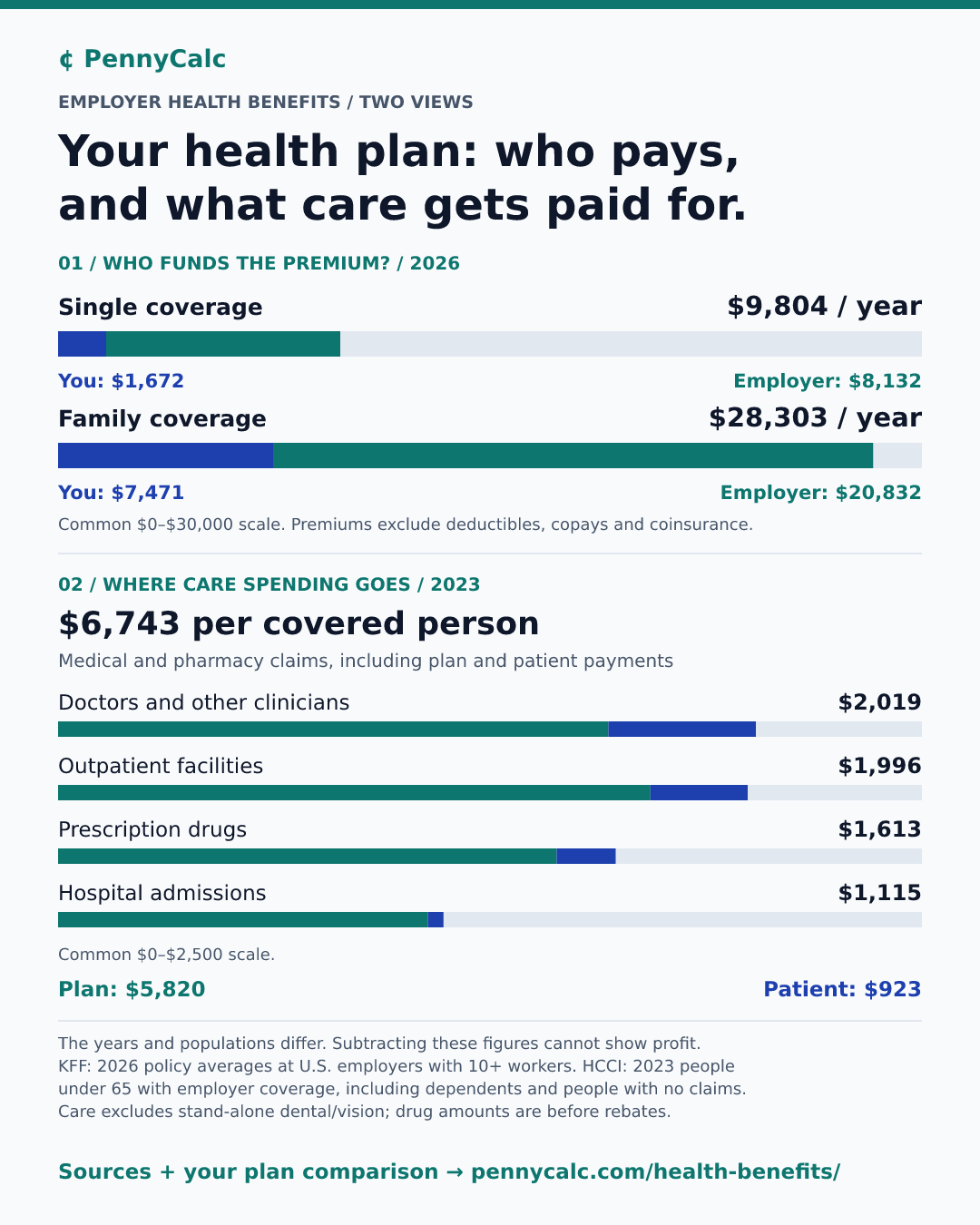
The full cost can be substantial. In the KFF 2026 employer survey, annual family premiums average $28,303. Workers pay $7,471 and employers pay the remaining $20,832. Below, we show that split alongside a separate question: how much is spent on care, and which services account for it?
01 / Premiums · 2026
Who pays for coverage?
Average annual premium for a covered worker’s single or family policy.
You: $1,672Employer: $8,132
You: $7,471Employer: $20,832
Both bars: $0–$30,000 per year
This pays for coverage. Deductibles, copays and coinsurance come on top.
02 / Care spending · 2023
Where does care spending go?
$6,743 per covered person, including dependents and people with no claims.
All service bars: $0–$2,500 per person
Plan: $5,820Patient: $923
Read these as two separate views. KFF shows 2026 premiums per policy. HCCI shows 2023 medical and pharmacy claims per person under 65. The years and populations differ, so the gap between them cannot tell us insurer profit. The care figures exclude stand-alone dental and vision, and drug spending is measured before manufacturer rebates.
Download the graphic · Download figures (CSV) · Sources and methods
Exact figures and source scope
| Coverage | You | Employer, calculated | Total |
|---|---|---|---|
| Single | $1,672 | $8,132 | $9,804 |
| Family | $7,471 | $20,832 | $28,303 |
| Service | Plan, calculated | Patient | Total |
|---|---|---|---|
| Doctors and other clinicians | $1,593 | $426 | $2,019 |
| Outpatient facilities | $1,714 | $281 | $1,996 |
| Prescription drugs | $1,443 | $171 | $1,613 |
| Hospital admissions | $1,070 | $45 | $1,115 |
| All services | $5,820 | $923 | $6,743 |
KFF 2026 survey, Figures 1.1 and 6.3. Covered workers at private and non-federal public employers with 10 or more workers in the United States.1,937 employers interviewed. Published 2026-10-22.
HCCI report, Figures 3 and 9, and source CSV, 2023 category totals (All / All). People younger than 65 with employer-sponsored insurance, including dependents and people with no claims; weighted for age, sex and geography. Published October 2026. Plan-paid = total claims minus patient cost sharing. Rounded labels may not sum; downloads retain source cents.
Both sources were checked on 2026-10-27. Claims reflect negotiated payments rather than providers’ list prices. The averages include people with very different needs, so they do not describe the median person’s use, a particular household’s bill or an allowance set aside for each member.
How does that compare with the care people use?
Insurance spreads the cost of care across people whose needs can be very different. Someone with a quiet medical year may use a small fraction of their premium; someone else may need care costing many times that amount. The average includes both, along with people who have no claims. It also matters that the premium figures are per policy, while the care figures are per person. A family policy can cover several people.
For a job offer, the employer’s contribution is worth considering alongside salary and other benefits. At open enrollment, the more immediate question is what each available plan would cost you. That means putting your premiums, expected care, employer account funding and tax effects together, after checking the doctors and medicines you need. You can do that in our HDHP vs PPO calculator, using your own plan terms rather than these national averages.
How much of the premium becomes insurer profit?
It’s a reasonable question once you see the size of the premium. To answer it, we need financial results for the same insurance business and period. The premium and care averages above cover different people and years, so subtracting one from the other would not give us a profit margin. Even a matching claims figure would leave administration and other expenses to account for.
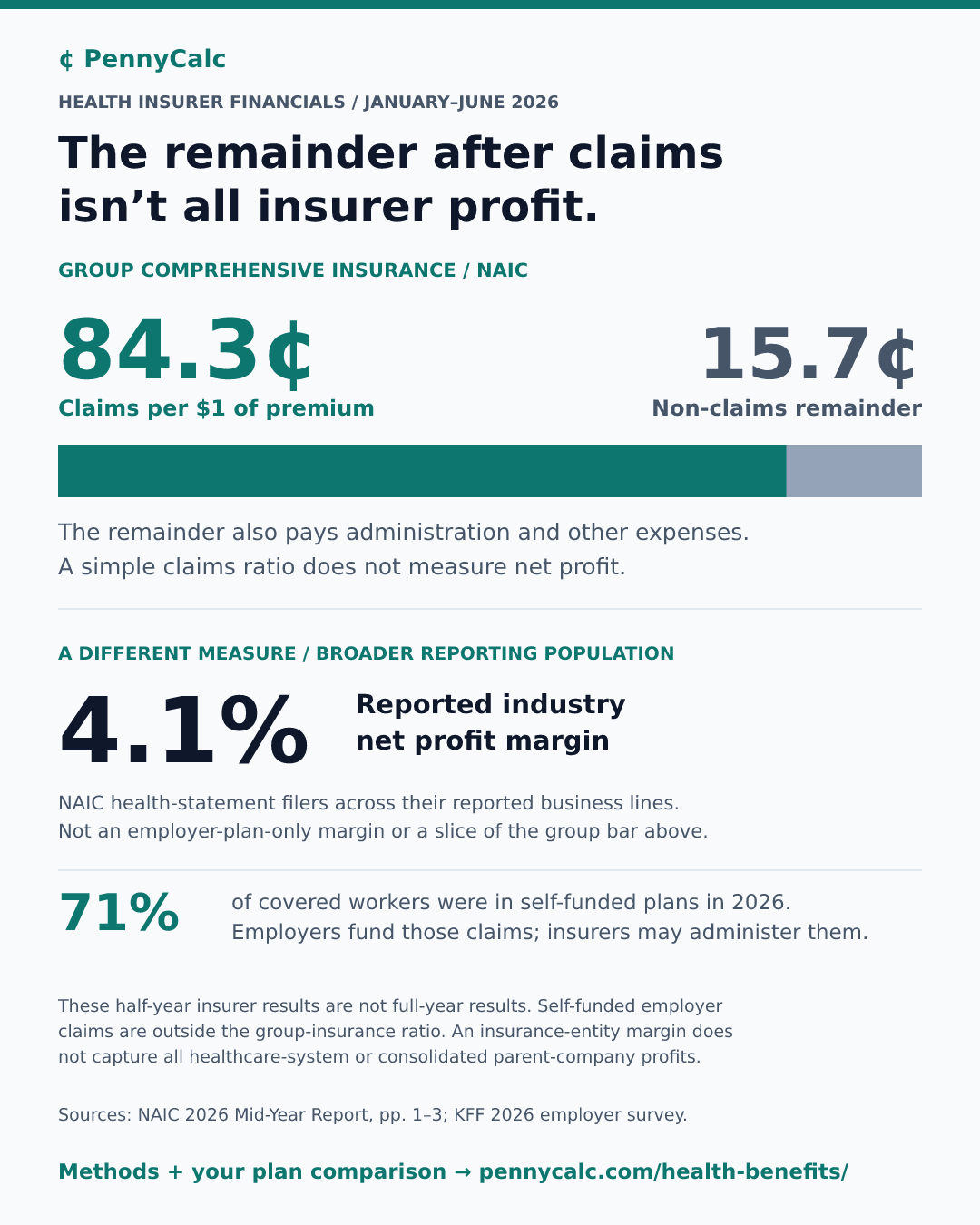
NAIC / January–June 2026 / Group comprehensive insurance
The remaining premium also has to pay for administration and other expenses. To find net profit, those costs need to be included as well.
Separately reported industry net profit margin
NAIC health-statement filers, across their reported business lines, January–June 2026. This covers a broader reporting population, so the figure cannot be read as a slice of the group-insurance bar above.
Many employers fund the claims themselves. KFF reports that 71% of covered workers were in self-funded plans in 2026. An insurer may administer the plan, but the employer funds the claims. Those claims are outside the group-insurance ratio above.
Download insurer-margin graphic · NAIC report, pages 1–3 · KFF self-funding figures
What these ratios can and cannot tell you
Group comprehensive insurance business reported to NAIC; excludes employers’ self-funded claims. Health entities filing the NAIC quarterly health statement, across their reported business lines; not an employer-plan-only or consolidated parent-company margin. A simple claims ratio is not the adjusted ACA rebate medical loss ratio. The non-claims remainder also pays administration and other expenses. The broader industry net margin is a separate measure and is not a slice of the group premium bar. Half-year results are not full-year results. Source checked 2026-10-27.
The ACA medical loss ratio rule answers a different question. It uses adjusted definitions, includes quality-improvement spending and generally uses a three-year period for rebates. Its 80%/85% requirements cannot be read as observed profit margins, and the simple claims ratio shown here cannot establish whether an insurer owes a rebate.
An insurer’s subsidiaries, provider businesses and pharmacy businesses can also have different financial results. This industry insurance-entity margin gives us one view of the business. It does not capture every profit across the healthcare system or explain, by itself, why your plan’s premium changed.
These figures help explain the business behind the coverage. Your enrollment decision still comes down to the plans available to you: the care they cover, the providers you can use, and what your household would spend under the same set of assumptions.
Frequently Asked Questions
Does the difference between premiums and medical spending equal insurer profit?
Is an HSA a type of health insurance?
Are dental and vision included in my medical plan?
Can I have both an HSA and an FSA?
Does the lowest premium mean the lowest annual cost?
Are employer HSA and HRA contributions the same?
Educational framework and scenario calculations. Benefits and eligibility depend on the actual plan and applicable rules. Read our methodology and report a correction.